



















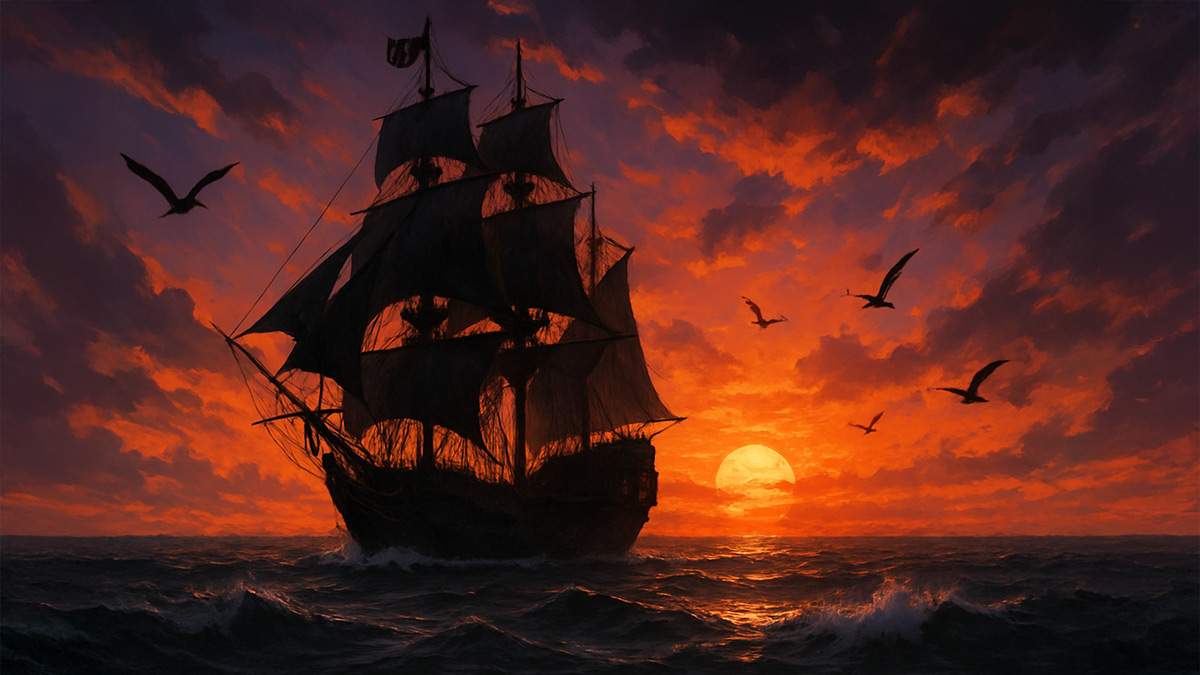

TLDR: The question of who the first pirate was leads us through ancient Egypt, Greek legends, and the golden age of sea raiding.
When most people imagine a pirate, they picture actor Johnny Depp playing the mad but likable swashbuckler Jack Sparrow, captain of the sailing ship the Black Pearl.
Depp’s pirate portrayal was inspired by seafaring bandits in older make-believe tales, such as Long John Silver in “Treasure Island,” Captain Hook in “Peter Pan,” or sailor Edmond Dantès in “The Count of Monte Cristo.”
Pirates in these stories were mischievous but also glamorous, courageous and mostly kindhearted. They wore flashy costumes. They had missing limbs, like Captain Cook’s iron hook for a left hand and Long John Silver’s wooden peg leg. They buried treasure chests of gold and silver, forced enemies to walk the plank and had talking parrots as shipboard companions.
They flew the Jolly Roger skull and crossbones flag from the ship’s mast to frighten enemies. The new Netflix series “One Piece,” which is based on a Japanese comic book, continues this popular depiction of pirates.
While fun, these portrayals of pirates are mostly invented.
I’m a political scientist who studies modern-day commerce raiding: robbing of private cargo vessels on the high seas. I’m interested in where it happens in the world, who does it and what can be done to stop it. My research finds today’s pirates to be less like swashbuckling Jack Sparrow and more like regular old thieves.
Pirates in the ancient world
Since pirates have been around for as long as people have moved things by boat, it is hard to pin down the very first pirate.
But archaeological evidence shows that boatbuilding goes all the way back to the ancient Egyptians, who used boats made from papyrus reeds as early as 6,000 years ago. These vessels likely carried valuable goods up and down the Nile River, and where valuable goods can be found, you can usually find thieves too. In fact, researchers know that pirates – basically just thieves on the water – targeted these river boats, because Egyptian pharaohs left records grumbling about pirates and their widespread pillaging.
By 3,500 years ago, thieves were using sailing vessels to raid coastal towns and villages in and around the Nile Delta, as well as the Aegean and Adriatic basins. Attacking ships far from land on the high seas and stealing the cargo was a logical next step in the tactics of seafaring raiders.

As trade increased across the Mediterranean Sea, boats carrying valuable cargo, such as pottery, silk, glass, spices and metals, became the targets of ancient pirates. Given the worth of these goods, pirate attacks became widespread across the ancient Mediterranean Sea. With money from the Roman senate and strong effort by a military leader named Pompey, the Roman navy worked hard to stop the pirates – and for a while it did.
The earliest named pirate?
The first mention of a pirate by name may have been in a Greek history book written in the fifth century BCE by an ancient historian named Herodotus.
He briefly describes the adventures of a naval commander by the name of Dionysius who was from Ionia, which is in modern-day Turkey. Dionysius set up a pirate base on the island of Sicily that allowed him and his fellow pirates to plunder ships that happened to sail past.
Pirates of the Caribbean
While Dionysius may have been the first recorded pirate, the most famous pirates lived during the 17th and 18th centuries, which came to be known as the golden age of sea piracy.
This was the heyday of pirates such as Blackbeard, also known as Edward Teach; William Kidd; Henry Morgan; Calico Jack; and Anne Bonny. They plundered Spanish treasure ships in the Caribbean, known as the Spanish Main, that were carrying silver from the mines in Bolivia back to the king of Spain.
Islands such as Jamaica, Tortuga and the Bahamas, as well the North Carolina coast, all became notable pirate havens. Port Royal, on the island of Jamaica, in particular, was a notorious pirate refuge. It was ideally positioned for preying upon Spanish galleons sailing across the Atlantic from ports in Panama and Venezuela. Johnny Depp’s character, Jack Sparrow, swashbuckled around a fictionalized Port Royal in the first “Pirates of the Caribbean” film.
21st-century pirates
The 2013 Hollywood movie “Captain Phillips,” starring Tom Hanks, drew attention back to real-world pirates and piracy. The movie was based on a real-life 2009 attack by Somali pirates on a ship named the MV Maersk Alabama, which was carrying food to Kenya. The 500-foot-long vessel and its crew were rescued by the U.S. Navy.
To better understand 21st-century piracy, my research team compiled data on all pirate attacks from 1995 to the present day. We found three main piracy hot spots: the Gulf of Aden near Somalia, the Strait of Malacca in Southeast Asia and the Gulf of Guinea off the coast of West Africa. All three locations experience the conditions that attract pirates: ship traffic, valuable cargo and weak governments.
Why become a pirate?
People become pirates for many reasons, not the least of which is to escape poverty and enslavement. Others just want adventure and to travel the world. These are the same motivations that drove commerce raiding in the ancient world, during the golden age of piracy, and even today.
While we may never know the first pirate, just like we will never know the very first thief, historical evidence shows that sea-raiding has been around since the very first boats traversed the world’s waterways. Despite efforts to end piracy, my research shows that the conditions that produce ship looting remain and will likely always exist.
Written by Brandon Prins, Professor of Political Science, University of Tennessee
This article is republished from The Conversation under a Creative Commons license. Read the original article.