













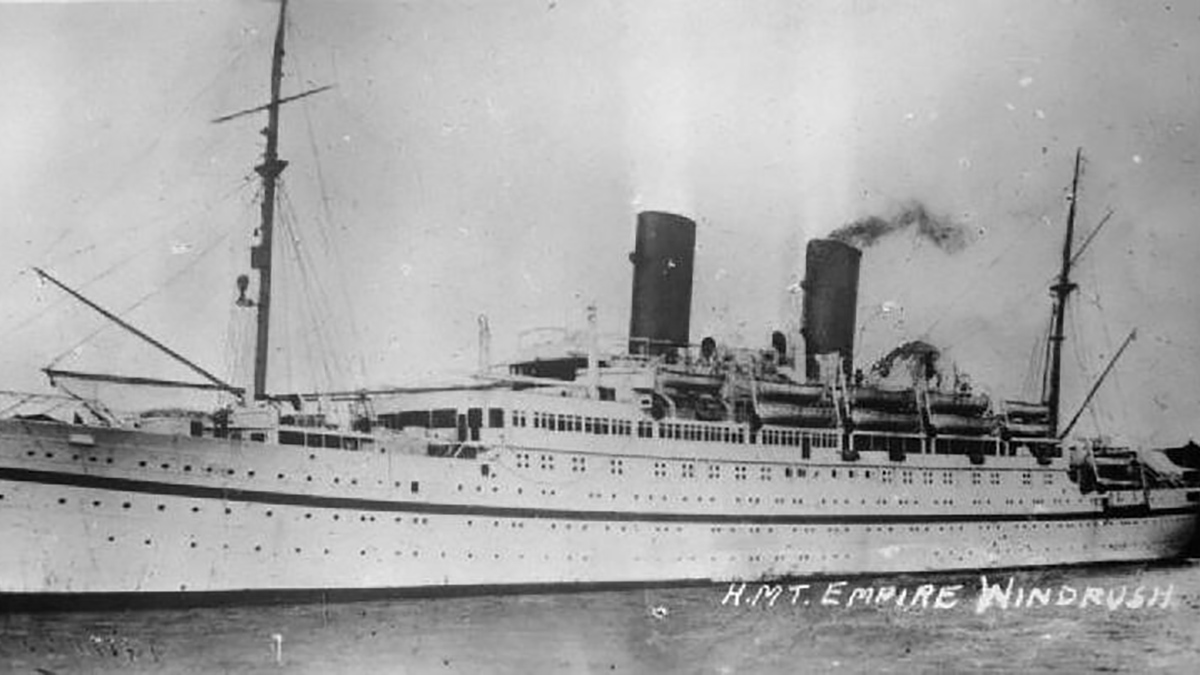

The outfits that new Caribbean arrivals to Britain wore as they disembarked the HMT Empire Windrush – and all the other boats that followed – served as a reassurance of their sense of self.
They had left their previous home behind and, at this stage of the journey, were caught between what was familiar and unknown. For many, the outfit worn on this day was talismanic. Their clothing choices signified their respect both for themselves and for the enormous, life-changing journey they had undertaken. Many men stepping off the boats wore well-cut suits, partnered formally with a shirt and patterned tie. Others donned more casual, open-neck shirts with the collars worn outside the jacket, all accessorised with berets or fedoras. And there were the staples – highly shined shoes, a belt and meticulous haircut.
Some of the younger travellers sported distinct styles. One young man arriving on the Empire Windrush wore a wide felt hat with the brim turned upwards, a broad and short tie that only reached the top of his chest, and a pinstriped, double-breasted jacket. He paired this with plain, generously-cut trousers that draped into a tight cuff at the ankle.
Women travellers wore a range of dresses, frilled blouses, cardigans to address the English chill and veiled half-crowned hats. The Trinidadian singer Mona Baptiste, who also travelled on the Empire Windrush, was photographed in hoop earrings, a dark skirt-suit and light-coloured collarless blouse patterned with flowers, which echoed a stunning floral broach pinned to the lapel of her jacket. Her high-heel shoes were slingbacks with round toes.
The clothes packed in the suitcases of these Windrush passengers were, in some cases, equally talismanic. A “Jamaica shirt” was brought to England by Winston Levy, father of the award-winning novelist Andrea Levy, to “remind him of Jamaica.”
The aesthetics of presence
The individualised styles of the Windrush generation as they settled into their new homes was, for many, a concerted expression of visibility. Their standout outfits were in some ways a response to feelings of invisibility, which stemmed from the hostility and racism many experienced upon their arrival.
English photographer Bert Hardy‘s 1949 photographs of West Indians in Liverpool include the barber known as Pee Wee (above). He is shown leaning on a lamppost wearing a distinctive, generously-cut overcoat, broad-brimmed felt hat and sturdy laced shoes.
But this spirit of visibility is perhaps best captured in the 1971 photograph of Trinidadian artist and textile designer Althea McNish (below), the first Afro-Caribbean designer to achieve international recognition.

McNish wears a blouse in her “Bezique” design while sitting among other examples of her work, which blended cultural references from Trinidad and elsewhere in the world, as well as contemporary design practices.
This blouse print was originally commissioned by the Irish designer Digby Morton, and became – according to Rose Sinclair, co-curator of the touring exhibition Althea McNish: Colour is Mine – McNish’s most successful.
‘Diasporic intimacy’ and parties at home
West Indian newcomers devised coping mechanisms for life in Britain. They developed a network of social events including parties, weddings and christenings that took place in homes across Britain.
These events were often enveloped in blue beat and ska, musical styles from Jamaica. The lyrics and rhythm offered a connection to their homeland that also boosted their sense of self-worth. This music was played alongside soul, blues and British pop.
These gatherings had a distinct aesthetic. Conversation took place (often in patois) while champagne glasses were retrieved from a glass cabinet. The glasses would gleam, filled with Babycham, as they were handed to women in cocktail dresses (often made by dressmakers within the West Indian community) and men in tailored lounge suits.
The foundations of a black British aesthetic were being laid. This West Indian contingent articulated the diaspora experience by blending distinct island styles and sensibilities with the fabrics, design details, homeware and cultural references of contemporary Britain.
The dress of subsequent generations
The clothing worn by the descendants of the Windrush generation is now part of a wider fashion defined as “Black British Style.” This term captures the myriad styles that have been devised as a distinct statement of belonging for those next generations who grew up in Britain.
This includes the 1960s black consciousness styles of Black Power, the 1970s Rastafarian military-inspired look, references to Africa through the colours red, gold and green, the 1980s sleek “lovers rock” silk blouses and pleated skirts, and the fashions associated with 1980s Buffalo music and the modern grime scene.
Black contributions to more cross-cultural subcultures and street styles are evident in punk, skinhead, goth and two-tone, as well as style-activist contributions to political acts such as Rock Against Racism, or the power of a t-shirt emblazoned with Black Lives Matter. Fashion designers including Walé Adeyemi, Joe Casely-Hayford, Grace Wales Bonner, Bianca Saunders and Nicholas Daley continue this legacy, articulating diaspora connections to Britishness through clothing, hairstyles and accessories.
What the Windrush generation means to Britain is so profound that they and their descendants have made a mark on almost every aspect of Britain’s culture, informing history, national identity – and not least, our sense of style.
Written by Carol Tulloch, Professor of Dress, Diaspora and Transnationalism, University of the Arts London
This article is republished from The Conversation under a Creative Commons license. Read the original article.