













Just 48 short years ago, movie director George Lucas used the phrase “A long time ago in a galaxy far, far away” as the opening to the first “Star Wars” movie, later labeled “Episode IV: A New Hope.” But at least four important aspects of the “Star Wars” saga are much closer – both in time and space – than Lucas was letting on.
One, the ability to add blue food coloring to milk, was possible even at the time the first film came out. But in 2024, “Star Wars”-themed blue milk became periodically available in grocery stores.
And we, an environmental health engineer and a civil engineer, know there are at least three more elements of these ancient, distant Lucas stories that might seem like science fiction but are, in fact, science reality.
Moisture farming
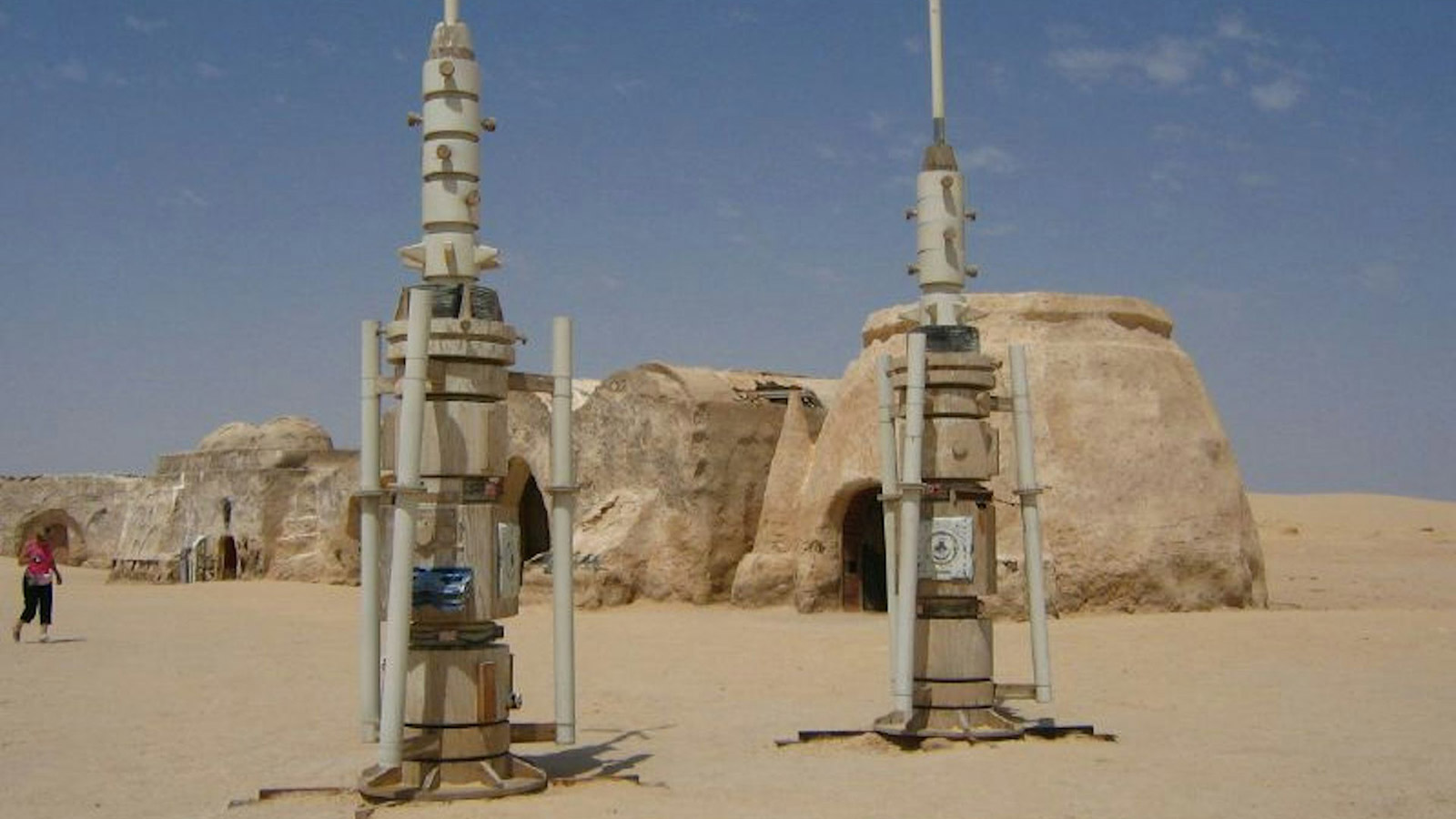
In that first movie, “Episode IV,” Luke Skywalker’s Uncle Owen was a farmer on the planet of Tatooine. He farmed water from air in the middle of a desert.
It might sound impossible, but it’s exactly what experts discussed at the second International Atmospheric Water Harvesting Summit hosted by Arizona State University in March 2025.
Related
- Real-Life Tech Inspired by ‘Star Wars’
- 7 ‘Star Wars’ Inventions That Could Exist in Real Life
- New Technology Brings Star Wars–Style Desert Moisture Farming a Step Closer
- Star Wars Technology in Real Life
Each day, a human needs to consume about the equivalent of 0.8 gallons of water (3 liters). With more than 8 billion people living on the planet, that means engineers need to produce nearly 2.6 trillion gallons (10 trillion liters) of clean drinking water every year.
Taken globally, rainfall would be enough, but it’s distributed very unevenly – including landing in the oceans, where it immediately becomes too salty to drink safely.
Deserts, which cover about one-fifth of the Earth’s land area, are home to about 1 billion people.
Researchers at places such as Berkeley have developed solar-powered systems that can produce clean drinking water from thin air. In general, they use a material that traps water molecules from the air within its structure and then use sunlight to condense that water out of the material and into drinkable liquid.
But there is still a ways to go before they are ready for commercial distribution and available to help large numbers of people.

Space debris
When the second Death Star was destroyed in “Return of the Jedi,” it made a huge mess, as you would expect when blowing to smithereens an object at least 87 miles across (140 kilometers). But the movie’s mythology helpfully explains a hyperspace wormhole briefly opened, scattering much of the falling debris across the galaxy.
As best as anyone can tell, a hyperspace wormhole has never appeared near Earth. And even if such a thing existed or happened, humans might not have the technology to chuck all our trash in there anyway. So we’re left with a whole lot of stuff all around us, including in space.
According to the website Orbiting Now, in late April 2025 there were just over 12,000 active satellites orbiting the planet. All in all, the United States and other space-faring nations are trying to keep track of nearly 50,000 objects orbiting Earth. And there are millions of fragments of space debris too small to be observed or tracked.
Just as on Earth’s roads, space vehicles crash into each other if traffic gets too congested. But unlike the debris that falls to the road after an Earth crash, all the bits and pieces that break off in a space crash fly away at speeds of several thousand miles per hour (10,000 to 30,000 kph) and can then hit other satellites or spacecraft that cross their paths.
This accumulation of space debris is creating an increasing problem. With more satellites and spacecraft heading to orbit, and more stuff up there moving around that might hit them, space travel is becoming more like flying the Millennium Falcon through an asteroid field every day.
Engineers at NASA, the European Space Agency and other space programs are exploring a variety of technologies – including a net, a harpoon and a laser – to remove the more dangerous pieces of space junk and clean up the space environment.
The Force itself
To most Earth audiences, the Force was a mysterious energy field created by life that binds the galaxy together. That is until 1999, when “Episode I: The Phantom Menace” revealed that the Force came from midi-chlorians, a microscopic, sentient life form that lives within every living cell.
To biologists, midi-chlorians sound suspiciously similar to mitochondria, the powerhouse of our cells. The current working hypothesis is that mitochondria emerged from bacteria that lived within cells of other living things. And mitochondria can communicate with other life forms, including bacteria.
There are many different kinds of mitochondria, and medical professionals are learning how to transplant mitochondria from one cell to another just like they transplant organs from one person’s body to another.
Maybe one day a transplant procedure could help people find the light side of the Force and turn away from the dark side.
May the Fourth – and the Force – be with you.
Written by Daniel B. Oerther, Professor of Environmental Health Engineering, Missouri University of Science and Technology and William Schonberg, Professor of Civil Engineering, Missouri University of Science and Technology
This article is republished from The Conversation under a Creative Commons license. Read the original article.