

















“What’s your type on paper?” is frequently asked by contestants on the popular reality dating show Love Island. “Rich, that’s certaine” responds Benedick, a contestant on “Nothing Island,” who appears to know exactly what he likes. “Wise, or I’ll none,” “virtuous,” “fair,” “mild” – though he concedes he is not fussed about hair colour.
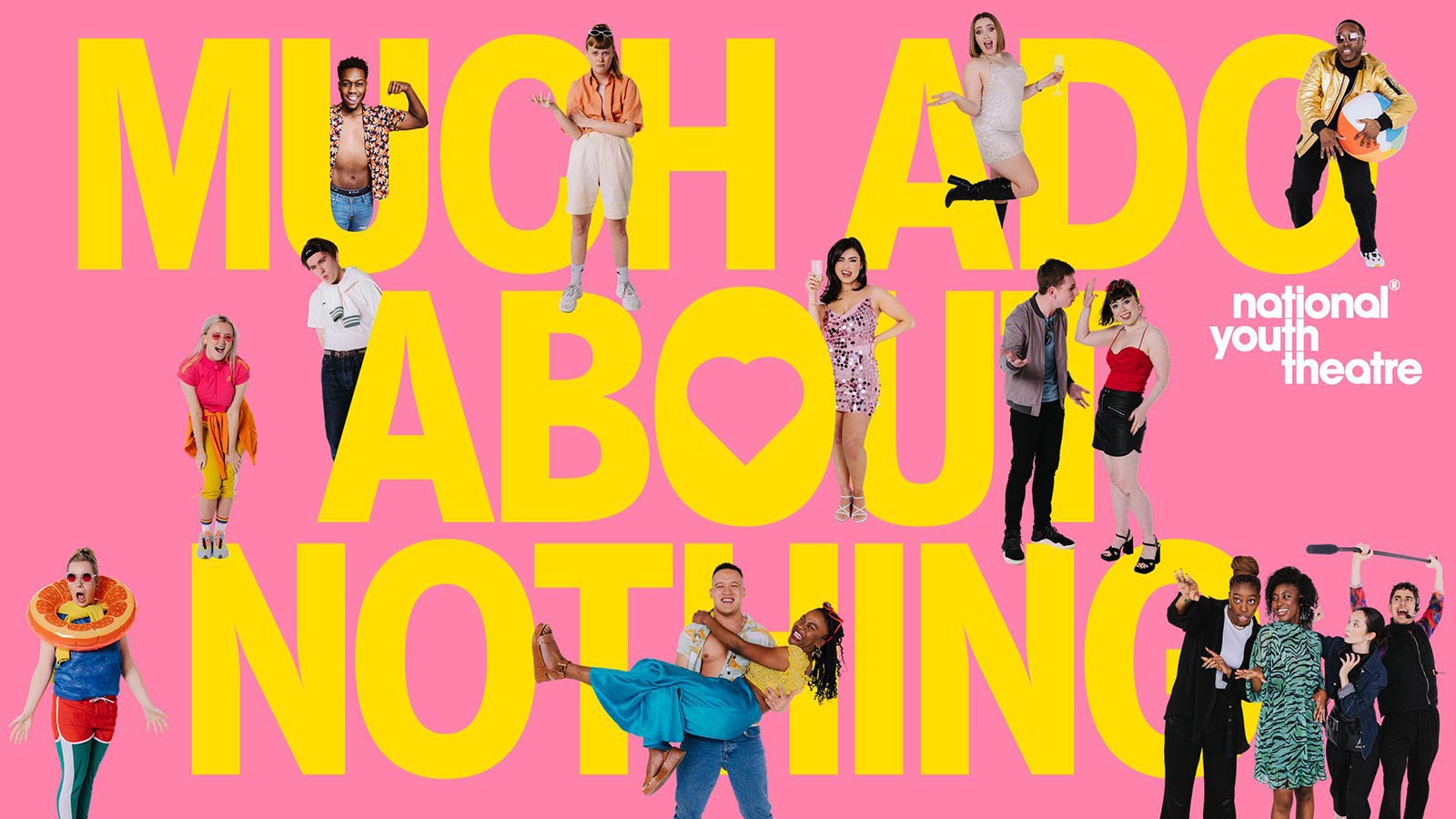
In this National Youth Theatre production celebrating their tenth anniversary, poet and playwright Debris Stevenson (Poet in Da Corner) adapts Shakespeare’s Much Ado About Nothing as the final segment of reality TV show “Nothing Island”. “If it ain’t love,” executive producer Leonato (Jessica Enemokwu) says: “it’s Nothing”.
Stevenson’s production is sprinkled with quotations from other Shakespeare plays. “To thine own self be true,” cautions on-set therapist Dr Dogberry (a brilliant new lease of life for Shakespeare’s nightwatch policeman). “To sleep perchance to dream,” says the executive producer as the islanders turn in the night before the finale.
However, King Lear’s caution: “Nothing comes from nothing” might be the overriding concern, as this production sets Shakespeare’s coupling and uncoupling within the nihilistic and superficial world of reality TV.
The concept, however, is an effective springboard. As Stevenson and director Josie Daxter explain:
We were forced to lean into the shared, uncomfortable realities of the play [patriarchy, misogyny, racism] and the TV show [superficiality, racism, heteronormativity] in order to expose and critique them. The lens made us braver.
Through innovative approaches, theatre productions can make the historical values of Shakespeare’s plays both understandable and relevant to modern audiences. This is exactly what has been achieved here.
Staging reality
The TV production set frames all the play’s action, in a coherent, if claustrophobic, 90-minute run time. What audiences see of the play, they also simultaneously see being manipulated by a production team for an off-stage TV audience, whose torrent of caustic, sentimental and superficial social media interjections appear on screens above the action.
The rationale for the villainy in Shakespeare’s original plot has shifted. Don John is still the disaffected and illegitimate sibling – now sister – of Don Pedro (both decried as “nepo babies”). However, in this adaptation, she is more puppet than puppeteer.
Conrad (played brilliantly by Tomas Azócar-Nevin) is now the arch manipulator as an ambitious “story producer”. With an eye over all the action, Conrad seeds rumours that bloom into reality TV gold. He whispers in people’s ears (headsets) providing prompts and cues.

At the height of one character’s public humiliation, when they are jilted at the altar and presumed dead, he says: “Oh! I think we are going to win a Bafta.”
The reality show elements of the diary room (soliloquies), staged competitions (Benedick and Beatrice’s first encounter is a girls v boys “rap battle”) and parties (the masked ball), map uncannily well onto the plot devices and structure of Shakespeare’s comedy.
Will surprise couple Beatrice and Benedick win this year, or will it be Hero, back from the brink of death, and her lover/abuser Claudio (Jez Davess-Humphrey)? The executive producer, herself a black woman, articulates her cynical certainty that TV audiences will never vote for someone who looks like her.
There are also some tensions or distortions produced by this amalgamation. That Beatrice still requires Benedick, a man, to “kill Claudio,” is a hangover of Shakespeare’s patriarchal society that feels out of kilter with the equality of the 50/50 gender split cast and female-led creative team.
Stevenson’s language is predominantly true to Shakespeare’s original play, with some deft interpolations and witty disjunctures: “I must cancel your company,” declares Benedick to Don Pedro.
However, the decision to keep other bits of original text (“he is as civil as an orange,” says Beatrice of the jealous Claudio, a pun on the sour imported Seville oranges of the 17th century, played here as a piece of nonsense), is unnecessary.
In other instances, Shakespeare’s verse is shown to excellent effect as rap and spoken word, though some of the play’s chipper couplets (“If it proves so, then loving goes by haps/ Some Cupid kills with arrows, some with traps”) could have been made more of.
Overall, this youth adaptation speaks with wit to a generation saturated in reality television and social media versions of love, who have missed out on real social contact during the COVID pandemic. The cynicism of the exposed reality TV strategies is counterbalanced by the warmth and joy of an assembled audience who laugh, gasp and click their fingers at this fast-paced and witty production.
If you want to know what love is, this adaptation suggests: switch off the reality TV and turn to Shakespeare instead.
Written by Penelope Woods, Lecturer, Department of Literature Film and Theatre Studies, University of Essex
This article is republished from The Conversation under a Creative Commons license. Read the original article.