











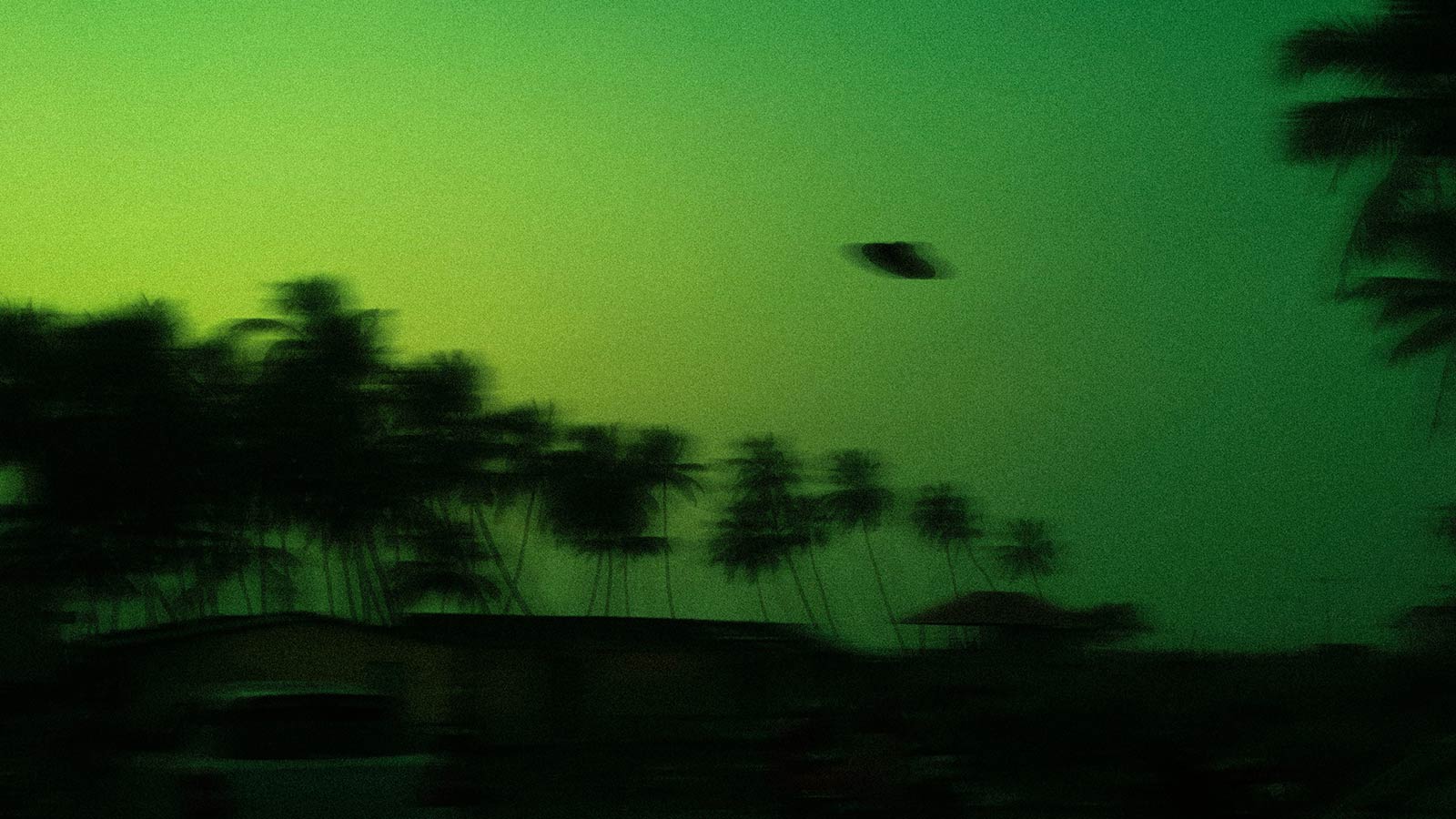

Do aliens exist? Could Earth really be the only planet hosting intelligent life?
Debates over the existence of extraterrestrials date back to the earliest Indigenous and western thought.
The tools generating the evidence within western science, however, have changed — from the philosophical and theological arguments of the Ancient Greeks to the development of increasingly sophisticated telescopes and space travel and exploration.
These include NASA’s missions to Mars, using a fleet of robotic orbiters, landers and rovers, and the development of the James Webb Space Telescope, which orbits the sun 1.5 million kilometres away from the Earth.
Philosophy and theology
Aristotle’s views on the nature of the cosmos dominated the Ancient Greek world. He argued that there’s only one world, at the centre of which is an immobile Earth. The planets move around the Earth. Beyond them is the sphere of the stars, or heaven.
“It is clear then that there is neither place, nor void, nor time, outside the heaven,” he wrote in On the Heavens. “Hence whatever is there, is of such a nature as not to occupy any place, nor does time age it.”
Aristotle’s teachings later created a storm in the Catholic Church, with various theologians worrying that Aristotle’s ideas were becoming too dominant. Étienne Tempier, bishop of Paris, responded to these criticisms by issuing the Condemnation of 1277, prohibiting the teaching of some 219 propositions — many of them derived from the teachings of Aristotle — and warning that those who disobeyed could be excommunicated.
In Proposition 34, Tempier took aim at those who, following Aristotle, claimed God could not have created other worlds. He argued that to adopt this position was to deny God’s omnipotence.
One theologian who pushed the argument about omnipotence further was Nicholas of Cusa. In his book, Of Learned Ignorance, published in 1440, he explicitly speaks of a plurality of inhabited worlds.
The invention of the telescope
A century later, Nicholas Copernicus lifted the Earth into the heavens in his book, On the Revolutions of the Heavenly Spheres, as the first thinker to suggest the Earth revolved around the sun. The Earth thus became a planet. And if planet Earth contains life, then was it not reasonable to argue that the other planets could also contain life?

The invention of the telescope in the early 17th century gave this notion further impetus. The telescope revealed, for example, that the moon is not perfectly spherical as Aristotelians believed, but is covered by craters and mountains and so is quite Earth-like.
By the end of the century, Bernard Le Bovier de Fontenelle had penned the first “scientific blockbuster,” Conversations on the Plurality of Worlds. Fontenelle speculated about living beings on all the planets of our solar system, as well as on planets orbiting other stars.
There was, however, little empirical evidence for these claims — a situation that would persist until after the Second World War.
The race to Mars
After the Second World War, national governments started to pour money into science, which was now seen as crucial to national well-being, and both astronomy and planetary science boomed.
In the United States, the space race with the Soviet Union and the battle for prestige also propelled spacecraft throughout the solar system.
At the beginning of the 20th century, a controversy had raged around some long, straight markings that people claimed to see on the surface of Mars. Some people believed that Martians had constructed canals to bring water from the planet’s poles to arid desert regions.
In 1964, the U.S. launched the Mariner 4 on a mission to Mars. The spacecraft flew by Mars in July 1965, taking the first photos of another planet from space. Instead of evidence of canals, these 21 photographs revealed the planet to have a cratered, moon-like surface.
By 1976, two American spacecraft were orbiting Mars, while on the planet’s surface, two other spacecraft conducted experiments, including scooping up and analyzing Martian soil to search for signs of life.
The James Webb Telescope
We now tackle the question of extraterrestrial life with even more powerful scientific tools. In 1995, astronomers Michel Mayor and Didier Queloz discovered the first planet orbiting a sun-like star, named “51 Pegasi b” or “Dimidium.”
As of now, NASA has confirmed more than 6,000 exoplanets, or planets outside our solar system, and billions are believed to exist.
The James Webb Space Telescope, located beyond the moon and some 1.5 million kilometres from Earth, is investigating the atmospheres of some of these exoplanets.
The Earth’s atmosphere blocks most of the infrared light from astronomical objects reaching Earth-bound telescopes. But the James Webb’s location enables its giant mirror to gather infrared light, which the spacecraft’s instruments then analyze, allowing astronomers to learn about the composition of exoplanet atmospheres.
The telescope has also employed instruments that block the light of the star around which an exoplanet is travelling so that the exoplanet itself can be imaged. There is as yet no confirmed evidence of life in an exoplanet’s atmosphere.
In 2025, however, a paper published in Nature claimed that a rock sample taken from an ancient dry riverbed in Jezero Crater on Mars by NASA’s Perseverance Mars rover could contain “potential biosignatures” of ancient microbial life.
So what are we to make of this ongoing search for extraterrestrial life? A quotation often attributed to science-fiction writer Arthur C. Clarke puts it well: “Sometimes I think we’re alone in the universe, and sometimes I think we’re not. In either case, the idea is quite staggering.”
Written by Robert William Smith, Professor of History, University of Alberta
This article is republished from The Conversation under a Creative Commons license. Read the original article.

5 Ways to Support HipHopCanada:
- Submit Your Music
- Follow Canadian Fresh (HipHopCanada’s Spotify Playlist)
- Follow us on Instagram
- Follow us on X (Twitter)
- Like us on Facebook