








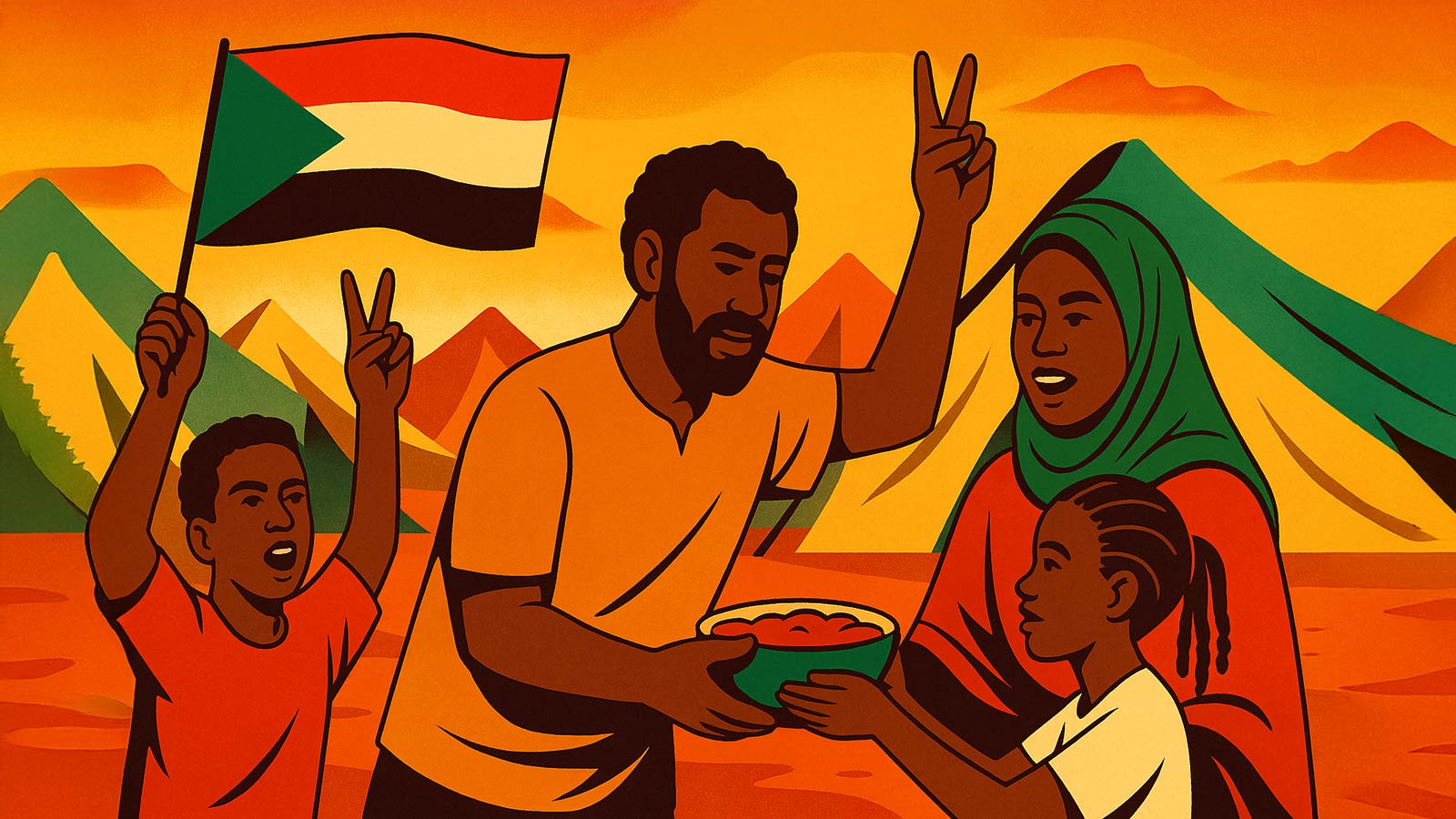

TLDR: The war in Sudan has created mass displacement and famine, but grassroots resistance groups are stepping in to sustain life and bring hope where the state has failed.
In this episode of Don’t Call Me Resilient, Nisrin Elamin, Assistant Professor of Anthropology and African Studies at the University of Toronto, paints a grim picture of life in Sudan today. She says the current war, which exploded on April 15, 2023, is devastating both rural and urban communities. Elamin also identifies small pockets of hope. In the absence of a properly functioning government and looming famine, grassroots groups are stepping in to help people survive.
Since last April, Sudanese people have been caught in the middle of a violent conflict between two warring military regimes — the Rapid Support Forces (RSF) and the Sudanese Armed Forces (SAF).
Human rights groups say the RSF and allied militias are responsible for large-scale massacres targeting specific ethnic groups in the capital Khartoum and the region of Darfur.
As a result of the war, more than 10 million people have been displaced from their homes, making Sudan home to the largest displacement of people in the world. A new report by a Dutch think tank says that if no changes occur on the ground, 2.5 million Sudanese people could die of famine by September.
In this episode, anthropologist Elamin says that alongside the strife, a new type of resistance has taken hold in Sudan. That resistance is part of the revolutionary movement that grew out of Arab Spring and the grassroots uprising that toppled the regime of long-time dictator, Omar al-Bashir five years ago.
Elamin explains how the current war is part of a long legacy of corrupt military rule and land dispossession that have plagued Sudan since its independence from British rule in 1956.
She also urges Canadians to pay attention to Canada’s possible role in Sudan’s war. War is big business, she says. In fact, Elamin says Canadians are likely complicit in most wars occurring in 2024. “We are complicit… through our pension funds, our university endowments, some of our personal investments. I think a lot of people aren’t paying attention to what’s happening in Sudan because they feel like it’s so far removed and it has nothing to do with them. But that is a lie. It does, and it might be closer than you think it is.”

Aladdin Mustafa / Pexels
Listen and follow
You can listen to or follow Don’t Call Me Resilient on Apple Podcasts (transcripts available), Spotify, YouTube or wherever you listen to your favourite podcasts.

Join the Conversation on Instagram, X, LinkedIn and use #DontCallMeResilient.
Credits
Associate producer, Ateqah Khaki and freelance associate producer, Latifa Abdin are co-producers of this episode. Other team members include: Jennifer Moroz (consulting producer) and Krish Dineshkumar (sound designer).
Vinita Srivastava, Executive Producer | Senior Editor, Culture + Society, The Conversation
This article is republished from The Conversation under a Creative Commons license. Read the original article.