
















The importance of cursive handwriting is a hot topic of debate within the world of educators. Now, a popular athlete has inadvertently become a champion of those who believe in the power of handwritten letters.
Joey Votto is one of the best baseball players to ever come from Canada. He has had an all-star career with the Cincinnati Reds for the last 17 years, but was without a job heading into spring training this year.
Canadian baseball fans were overjoyed with the announcement earlier this month that Votto, a native of Toronto, had signed a minor-league contract with the Toronto Blue Jays.
But the signing also caused some Canadian fans to remember remarks he made in 2018 when he said: “I don’t care almost at all about Canadian baseball.”
Three-page letter
Votto chose to address those six-year-old remarks in an unusual way: he posted a three-page handwritten letter on X (formerly Twitter) to ask for forgiveness.
Fans’ comments about the letter focused on two things: most people appreciated the apology, but just as many were struck by the fact that Votto chose to make the apology in cursive handwriting. One commenter even said the letter was nice, but “no one under 30” will be able to read it — a reference to the fact that many students are no longer taught cursive writing.
Within just 24 hours, the note received widespread attention from Canadian media as well as Votto’s enormous following on X/Twitter, garnering some 1.8 million views.
Votto’s reflections afford opportunities for personal understanding, growth and healing — especially because they were handwritten.
In retrospect, Votto acknowledged, his ill-thought comments were an embarrassment and a shame for him personally, and a disappointment to his mother. In the letter, Votto seeks to assuage the emotional burden by taking responsibility for his comments and asks forgiveness from those he thoughtlessly hurt.
“Oof, wow, I cringe and am ashamed as I re-write my words,” Votto wrote in the letter, referring to the original comments that got him into hot water.

Handwriting makes it authentic
The fact that Votto chose to write the letter in cursive makes the apology that much more authentic: had he typed it out, readers could have assumed that someone else or a computer program chose the words.
But the handwritten note clearly shows Votto’s emotional commitment to the apology — including some grammatical errors that a computer would have corrected. (There’s been some speculation that Votto wrote the letter on a “paper tablet,” but there’s no doubt it’s his writing.)
For those who take an interest in handwriting and its connection to making meaning on the page, it is noteworthy that Votto’s handwriting is fully cursive.
It shows many connections between letters and, secondly, it’s characterized by many twists, loops, backward turns — the type of script that was likely favoured in 40-year-old Votto’s young years in grade school in Toronto.
Though more cumbersome for many young learners, such features of handwriting help to determine the authenticity of the writing: every hand has its unique musculature and grip, as well as style in making the ligatures or joins between letters, the loops and tails.
When compared to another sample of an author’s handwriting, the authenticity of cursive writing can be determined — an important dimension for writing of historical importance.
A personal connection to the words
In Votto’s case, his handwritten letter shows sincerity of expression and a personal connection to the words.
The ability to show his true feelings is possible by developing a script that is fluent and automatic, thus making precious cognitive resources available for generating the intended message.
This means that handwriting must be over-learned and brought under unconscious control. In establishing neuronal connections, fluid movement is possible that, in turn, permits access to le mot juste: the right word at the right time for the right purpose.
As a researcher who has advocated for the return of cursive handwriting to classroom teaching, I believe it’s important to note that handwriting creates the neurocircuitry to the brain for making meaning, storing, retrieving and remembering. This is known as embodied cognition.
Our hands have a profound effect on how our brain makes sense of the world and how we think. Readings of student brains suggest writing by hand may increase brain connectivity more than typing.
Handwriting affords a sense of agency and empowerment, as witnessed by the cursive writing of Nobel Peace Prize winner Malala Yousafzai’s note about how “one pen, one child, one teacher can change the world.”
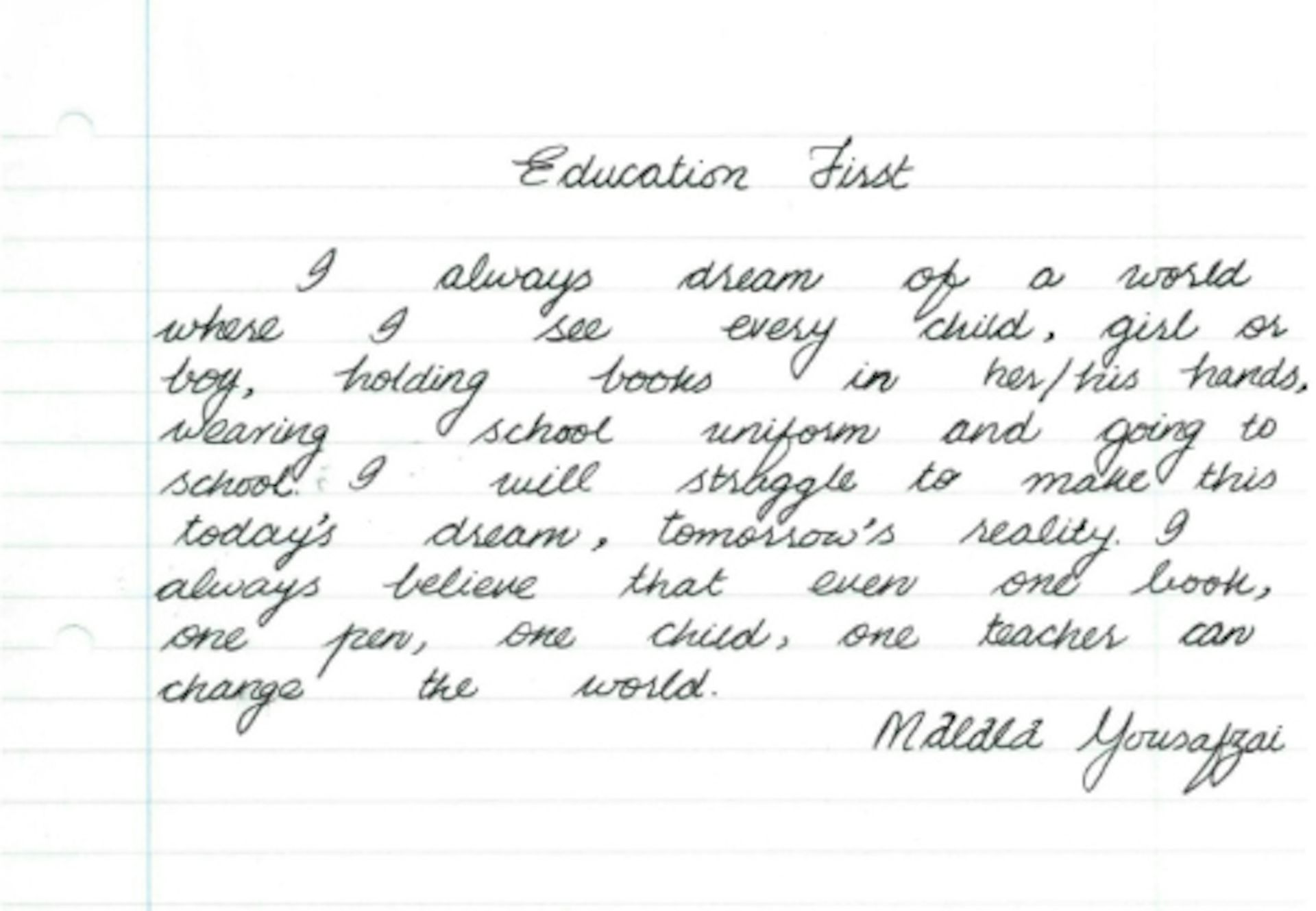
A handwritten note by Nobel Peace Prize winner Malala Yousafzai.
Votto is on a Cinderella-like quest to finish his career with his hometown baseball team. Whether he makes it or not won’t likely be known for a few weeks.
But regardless of whether he ever plays for the Blue Jays, Canadian baseball fans have clearly appreciated that Votto took the time to write a three-page letter in his own hand to right a past wrong.
Written by Hetty Roessingh, Professor, Werklund School of Education, University of Calgary
This article is republished from The Conversation under a Creative Commons license. Read the original article.