












TLDR: AI music lawsuits are raising new questions about copyright, artist livelihoods and the growing influence of U.S. tech companies on Canadian music.
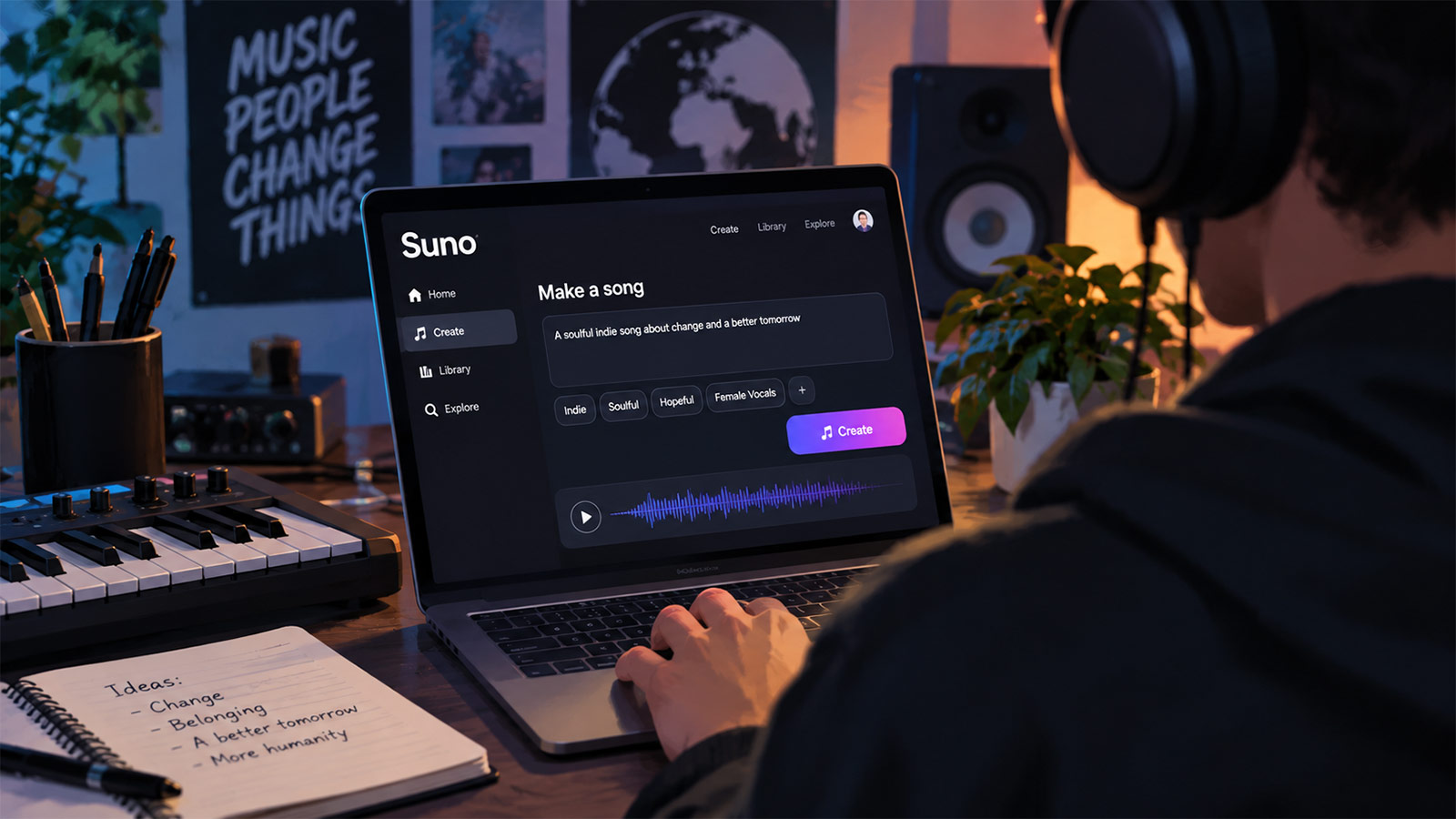
A Canadian non-profit performance rights organization is suing Suno, an American genAI music creation platform, over streaming AI outputs that allegedly replicate songs without consent or compensation.
The Society of Composers, Authors and Music Publishers of Canada (SOCAN) lawsuit cites 150 Suno songs that it says are identical or nearly identical to the works of Canadian artists including Joni Mitchell, The Weeknd, The Tragically Hip and others.
SOCAN wants the AI company to comply with copyright law and for artists to have a say in how their works are used (or not).
The statement of claim, which seeks $20,000 per work and $10,000,000 for infringement, joins a series of recent lawsuits against Suno.
These include a US$500-million joint copyright lawsuit originally launched by major labels of Warner, Sony and Universal (Warner has since signed a licensing deal with Suno) and a class-action lawsuit from Jason Isbell and other musicians. There are also music publisher and record label lawsuits.
SOCAN’s lawsuit raises questions about the place of Canadian artists in a music industry increasingly shaped by American tech companies.
Musician livelihoods at risk
A wide range of issues pertaining to AI technology and musicmaking are putting musician livelihoods at risk.
“It definitely feels like an existential struggle for artists today against AI,” rapper Cadence Weapon told The Canadian Press. The artist says 129 of his songs have been found in datasets to train AI music generators.
We conducted a survey this past summer with 267 working musicians in Canada. The survey was sent to 1,025 musicians (Polaris-longlisted artists between 2006-25 who have appeared on the Earshot charts seven or more times with Gold records; some were added for geographic representation).

We asked 26 questions about their music-making and relationships to aspects of the music industry, including companies like Spotify, Live Nation and Suno.
Musician responses
We found that 87 per cent of respondents view AI technology in music creation negatively.
One respondent said they are “personally and professionally offended by the existence and use of genAI tools for artistic practices” and that the AI tech tools encourage the theft of copyrighted works.
Another said AI tools are compromising musicians’ ability to make money from music. One artist said they avoid AI “like the plague.”
The majority of survey responses indicate a clear line between creativity and the type of music production encouraged by a platform like Suno.
These artist responses challenge the way Suno is marketed to users. A recent post by the company said that Suno is “grateful to build tools that let everyone experience the joy of making music.”
The survey also found many Canadian musicians feel forced into using particular tools or platforms, or forced to work with large companies that dominate within a particular sector of the music industry.
In one survey response to a question asking about an artist’s relationship to ticketing company Ticketmaster and concert promoter Live Nation, the respondent said they are in “a relationship, but forced into it.”
Proliferating AI-generated content
AI music is becoming a battleground over the future of tech, culture and community.
In January 2026, Billboard magazine reported on a media consumption survey that found the vast majority of music consumers in the United States are uninterested in engaging with AI-generated songs as well. Another U.S.-based survey documented increased discomfort with GenAI in music, especially among younger listeners.
Part of this growing distaste for AI music comes from increased exposure. A recent example of this unwelcome intrusion happened when one of the authors of this story was listening to YouTube Music and was algorithmically recommended an AI song, which had a similar sound to the country-folk artist that was originally selected.
The YouTuber whose profile is listed as posting this song is Lee Vybrony, who uses AI avatars of sexualized women to generate videos for a range of AI-generated songs and whose profile has more than 32,000 subscribers.
One of Vybrony’s songs, “Both Sides of Us,” seems to rip off Joni Mitchell’s “Both Sides Now.”
Trade, sovereignty concerns
For Canadian musicians, artists and other creators the stakes are raised by the current trade war with the U.S.
During the latest skirmish over tariffs, U.S. negotiators demanded Canada drop requirements for streamers like Netflix to promote Canadian content.
But Canadian cultural production should not be sacrificed. If anything, the hostility toward our sovereignty and protecting our culture should be a call to strengthen these laws and support Canadian artists.
Artist input into copyright
In addition to efforts by SOCAN and others to stop the exploitation and mining of artistic works, a broader range of solutions are needed if we are to ensure artist livelihoods are protected and celebrated. It’s important that artists influence policymaking, particularly copyright law.
AI-generated music needs to be labelled on streaming platforms. Listeners should be empowered to filter it out if they choose. Ideally, users should have to opt-in to AI-generated music.
The Online Streaming Act should be expanded to require a certain percentage of Canadian content be heard, viewed and promoted across online and streaming platforms, just as Canadian content regulations have done for broadcast radio.
Tighter regulation, more competition
We also need to advocate for digital tools and platforms that are built and regulated in Canada, as well as more competition in the music industries.
In the U.S., a jury recently decided Live Nation and Ticketmaster have operated as a monopoly and overcharged fans. Recently, the Consumers Council of Canada filed an application to sue Live Nation in Canada around similar concerns.
And as we’ve documented, consolidation in the Canadian music industry by non-Canadian companies has only tightened: Universal, Warner and Sony have a triopoly in the recording and publishing market; SiriusXM has a monopoly in satellite radio and Google/YouTube, Spotify, Apple and Amazon have an oligopoly of the streaming music market.
“Now old friends are acting strange,” Mitchell wrote back in 1967, after she had relocated to the U.S. from Canada a couple of years prior.
“Well something’s lost,” Mitchell laments, “but something’s gained.” Through strategic opposition to tech platforms and music monopolies, we could gain a music industry that allows Canadian music to flourish.
Written by Brian Fauteux, Associate Professor Popular Music and Media Studies, University of Alberta; Andrew deWaard, Associate Professor, Department of Communication, University of California, San Diego, and Brianne Selman, Scholarly Communications & Copyright Librarian, University of Winnipeg
This article is republished from The Conversation under a Creative Commons license. Read the original article.