










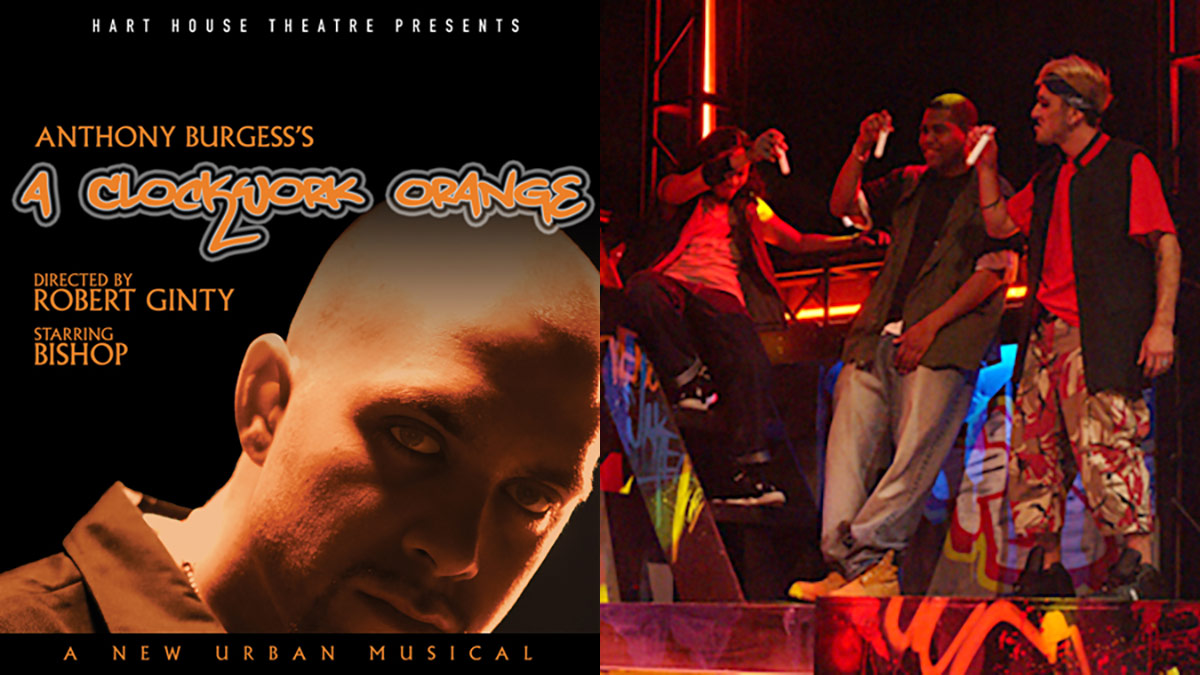

Originally published by HipHopCanada on Sept. 20, 2004, this review by associate editor Julia Che revisits the late Robert Ginty’s hip-hop adaptation of A Clockwork Orange at Hart House Theatre. The production starred the late Bishop Brigante as Alex DeLarge alongside Canadian rapper Rochester aka Juice, with beats by DJ Spinster, breakdance performances by the Drunken Monkz and other members of the hip-hop community involved throughout.
More than two decades later, HipHopCanada reached out to Doug Floyd, who was credited as Marketing and Production Manager on A Clockwork Orange – A New Urban Musical, served as one of its producers and also appeared in the small role of Rubenstein. Today, Floyd is Director of Theatre and Performing Arts at Hart House, University of Toronto.
Looking back on the 2004 production, Floyd remembers a show that was ahead of its time in some respects, bringing both new audiences and new performers to the historic Hart House Theatre stage. Its cast brought together emerging theatre artists, experienced community performers and artists from Toronto’s hip-hop scene. At the centre of that mix was Bishop.
“Bishop was at the heart of this authenticity. His participation and taking on the lead role of Alex was the credibility that the production required. Once he was in – everything else just fell in place.”
Floyd acknowledges that the production “wasn’t perfect by any means,” but says perfection was never what Ginty was pursuing. Instead, the late director wanted a fresh and deliberately raw interpretation of a familiar story, updated for Toronto in 2004. For some audience members, A Clockwork Orange was their first experience seeing a play or musical, while Floyd says people continued to tell him for years afterward that it was one of the most unique productions they had seen.
The experience also offered something new to the artists stepping onto a theatrical stage without traditional acting backgrounds, including Bishop.
“I don’t think Bishop really knew what he was getting himself into at the time! At the end of the process, Bishop was very proud of what he accomplished with A Clockwork Orange and I hope it had a positive effect on his work and life. I will remember Bishop as being extremely grateful for his experience here, a leader, and in general a down to earth, naturally funny and talented performer.”
More than 20 years later, Floyd’s memories add another dimension to an early chapter in Bishop Brigante’s career and a unique moment when Toronto hip-hop found an unlikely home on one of the city’s historic theatre stages.
Below, revisit Julia Che’s original HipHopCanada review of A Clockwork Orange – A New Urban Musical, first published Sept. 20, 2004.
Review: A Clockwork Orange – A New Urban Musical
Written by Julia Che
If you’ve read A Clockwork Orange by Anthony Burgess, you’ll know why the story sparked so much discussion when it was published in 1962. Comparably fervent dialogue arose when the screenplay, directed by the experimental Stanley Kubrick, was released in 1971.

A Clockwork Orange is an introspective and graphic exploration into the depths of the human psyche, an inquiry into ideas of good and evil, freewill and predestination, and individualism and conforms of society. The play raps about psychological oppression and governments exercising power over young people reflecting separation between youth and the establishment, which in the mid 1960’s was of popular discussion in Britain.
Bishop Brigante stars in A Clockwork Orange – A New Urban Musical (Photo: Courtney Gibson / Hart House)
Furthermore, it’s an allegory of Christian free will. Man is defined by his capacity to choose courses of moral action. If he chooses good, he must also have the possibility of choosing evil. Evil is a theological necessity. Burgess dealt with these issues in an undeniably brilliant fashion making the novella one of the greatest, most thought-provoking stories of the 20th Century.
MTV director, Robert Ginty reaches from the states wanting to make this production “excite and reengage Toronto’s young audiences.” With an excessive number of killings and gang attacks in the G.T.A. within the past few years, the city has seen more than its share of violence. He expresses, “I see the ‘outlaw’ hip-hop inner city culture as being at war with establishment authority,” making the story of A Clockwork Orange a perfect fit for the University of Toronto’s theatre.
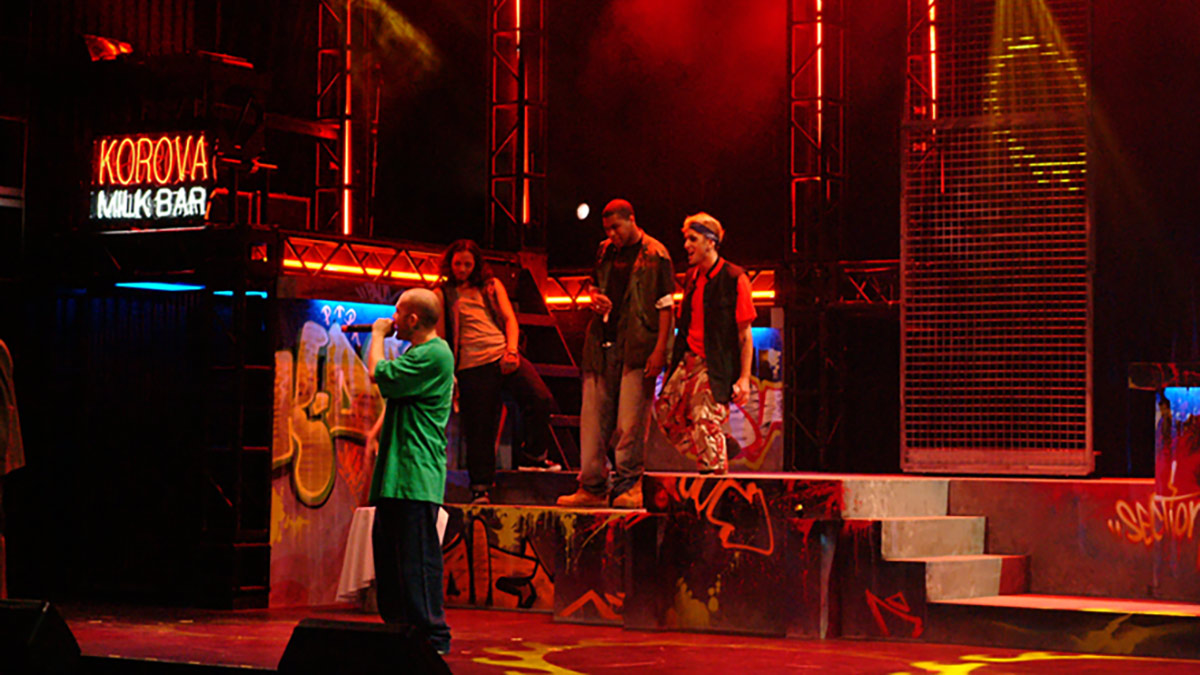
Hart House Theatre’s presentation of A Clockwork Orange had all the elements of a hip-hop production: graffiti painted set, emceeing by select cast, beats by DJ Spinster, and breakdance interludes by the Drunken Monkz. Fortunately, one hip-hop facet that the play did lack was the two-hour “hip-hop time” delay (HHC readers, you know what I speak of). With an expected full house, the venue was about three-quarters full at a quarter after eight.
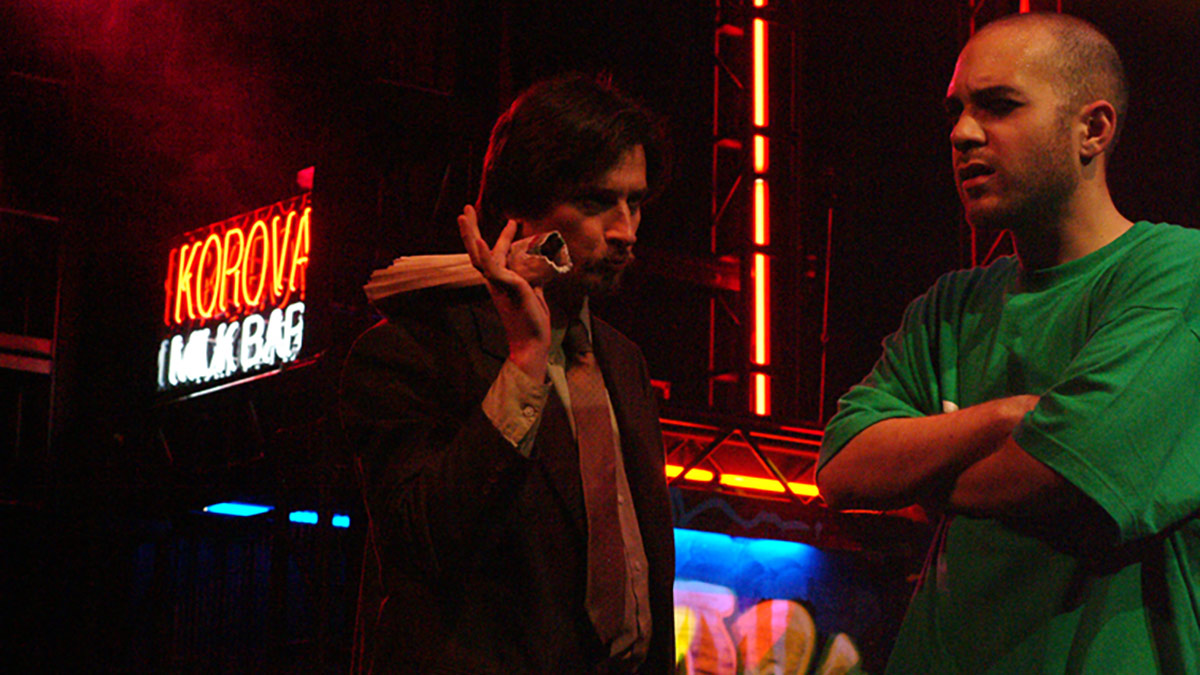
Bishop performs as Alex alongside the cast of A Clockwork Orange (Photo: Courtney Gibson / Hart House)
The setting was typical street, resembling a little of the musical Rent with a grungy urban alleyway feel. With a set of three levels, the DJ and narrator were appropriately separated on the top level from the rest of the action. Although, executive producer, Paul Templin says that the budget for the production was minimal, the set was laced with graffiti, wire caging, creative lighting, and neon signage appropriately contributing to the tone of the show.
A real horror show of youth culture, the play begins with a diabolical orgy of criminality. The protagonist, Alex is played by Toronto emcee, Bishop Brigante. With fanatical interests of rape, torture, murder and Beethoven, Alex is, to say the least, a disturbed youth.
The sociopathic young man heads a crew of ‘Droogs’ including Dim (Kalen Hayman), Pete (Rochester aka Juice), and Georgie (Byron Abalos). The sadistic gang perform vile acts upon society, soon things go down and Alex is imprisoned. With one chance for early release he undergoes an experimental Pavlovian treatment trial. Dr. Brodsky (Joel Grothe) forces upon Alex horrifically violent film programming with the accompaniment of Beethoven’s symphonies. Accordingly, Alex is sickened by the thought of violence and by the same token, classical music. Alex is assessed as “cured” and is released back into society lacking his urges for violent engagement.
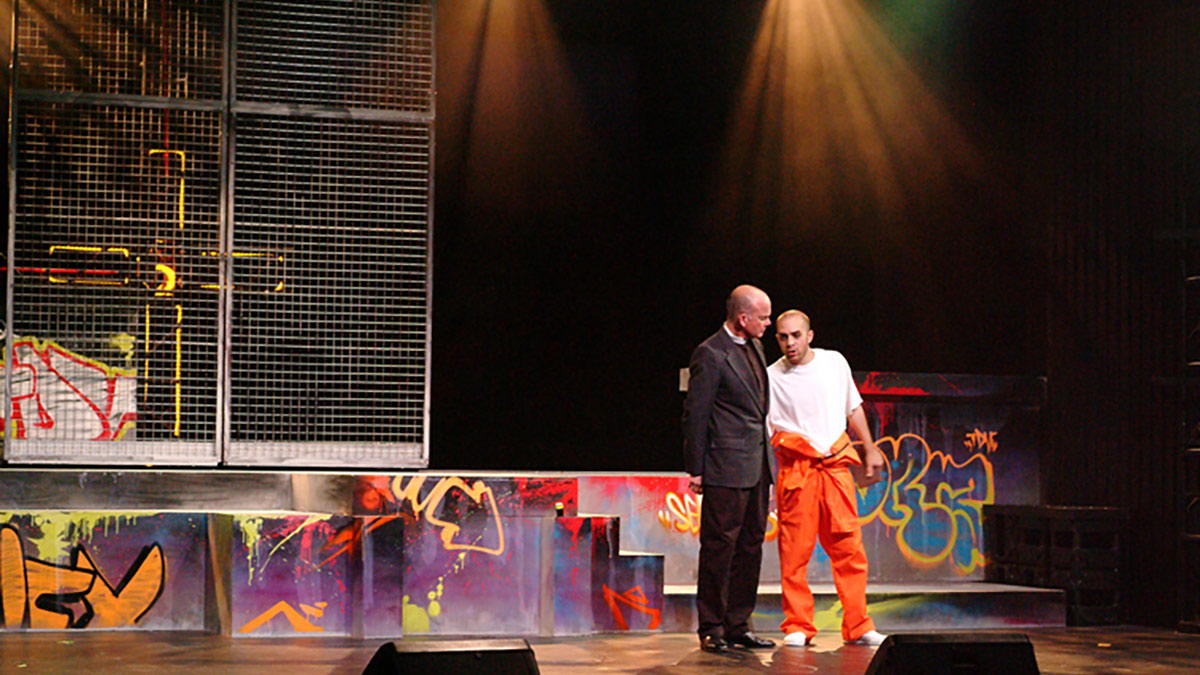
Bishop Brigante takes the stage as Alex DeLarge (Photo: Courtney Gibson / Hart House)
Burgess confronts the concept of moral persecutions and Pavlovian experiments on humans. When Alex is programmed to become sick at the thought of violence, he assumes the ownership of the play’s title. Or as the prison chaplain says, “When a man ceases to choose, he ceases to be a man.” The story of A Clockwork Orange examines the idea of freewill forcing its audience to confront the disheartening choice between two evils: random acts of violence or a state of grey totalitarianism where youthful aggression and passion is controlled.
Prior to the audition, Bishop had never even heard of the novella and evidently, knew nothing of what or whom A Clockwork Orange entailed.
Bishop says, “I thought maybe I was doing a cameo or something. I didn’t know I was going to audition for the main role… When I went into the audition. I had never read the book or seen the film. I found out that the whole play is surrounded around Alex.”
The talented emcee impressed both Templin and Ginty and linked, winning the lead role over fellow Toronto lyricist k-os.
On working with Ginty, Bishop gives major props to the pop-culture director, “He’s the only guy, to appear on The Love Boat and kill somebody! He’s the only guy ever responsible for a death on The Love Boat! He’s a legend. So I’m taking his wisdom and using it to my abilities.” Bishop says working with him was inspiring. He felt that Ginty was able to draw out every ounce of emotion, “I was like… I don’t think I can do that. But when I think I can’t do something, that’s when I strive to do it. So now I’ve done it!”
In addition to memorizing lines, Bishop found the Nadsat language a challenge to learn. Burgess’ original language was the dialect of Alex and his Droogs, originating from Slav propaganda and Shakespearean English. Ginty used the original Nadsat also incorporating hip-hop slang. Whether it was the volume of the background music or the fusion of the various vocabularies, the Droog language was somewhat incomprehensible at first. Though, by the second or third scene, the Droogs were much more intelligible revealing Bishop’s exceptional dramatic talents surprising audience members.
One spectator noted, “I never expected a performance like that from Bishop. As a freestyle emcee, you’d never really place him in such an animated and whacked-out role.”
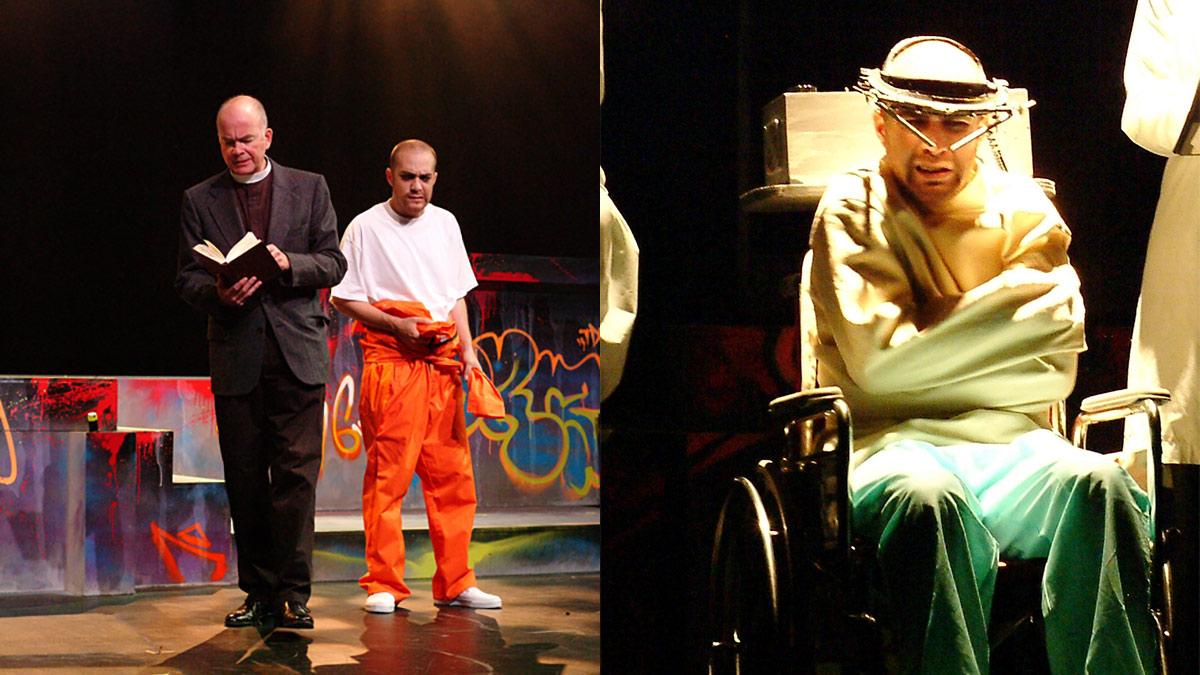
Alex undergoes behavioural conditioning in a pivotal scene (Photo: Courtney Gibson / Hart House)
One of the more memorable scenes of the lyricist’s performance was his reaction to the Pavlovian-style experiment. Alex reacts to the dire violence and horror that he sees on a film projection, which is accompanied by Beethoven’s classics. Directly facing towards the audience, as if it were the projector screen, Bishop plays a convincing Alex with focused eyes and frighteningly urgent cries.
As written by Burgess, the violent film is complimented by Beethoven’s classic symphonies. Although Alex’s ultra-violent sociopathic side was well developed, his more refined side of his love for classical music was lacking. It was during Alex’s experience with the Pavlovian experiment that the audience was first exposed to his love for Beethoven. Without fully developing character Alex’s interest in music, the audience was left somewhat confused.
As expressed by a hip-hop industry insider, “I didn’t really grasp where Alex got his love for classical music. I thought that this characteristic could have been developed further, introducing the classical music even before we see him in the chair.” Also suggesting, “Instead of Beethoven, I would have liked to have seen some soul, like Al Green’s ‘Simply Beautiful.’” A keen insight, classic soul may have been more suitable. Classical music has become a typical avenue in film within the past decade to further the effect of graphic violence. Would classic soul have had the same effect? Maybe — maybe not, but either way, a relevant suggestion.
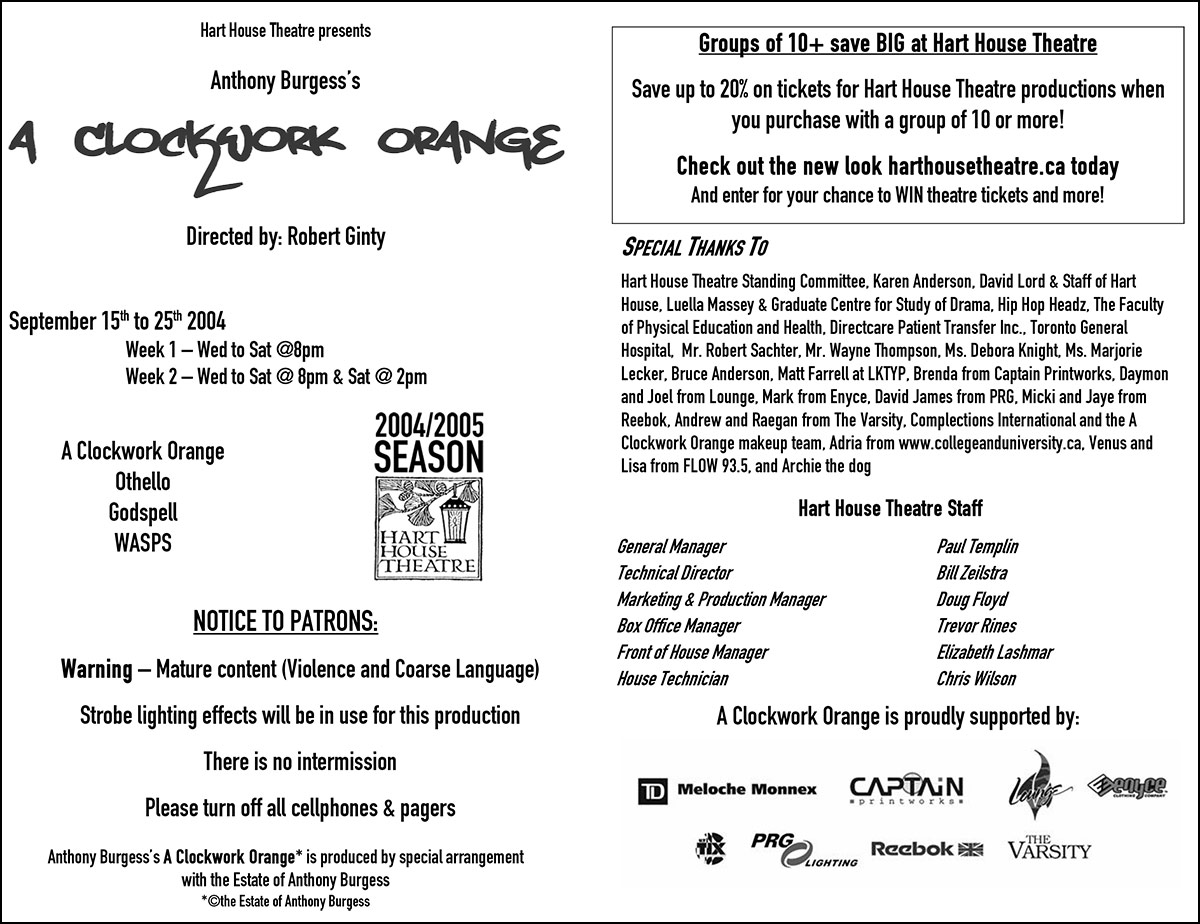

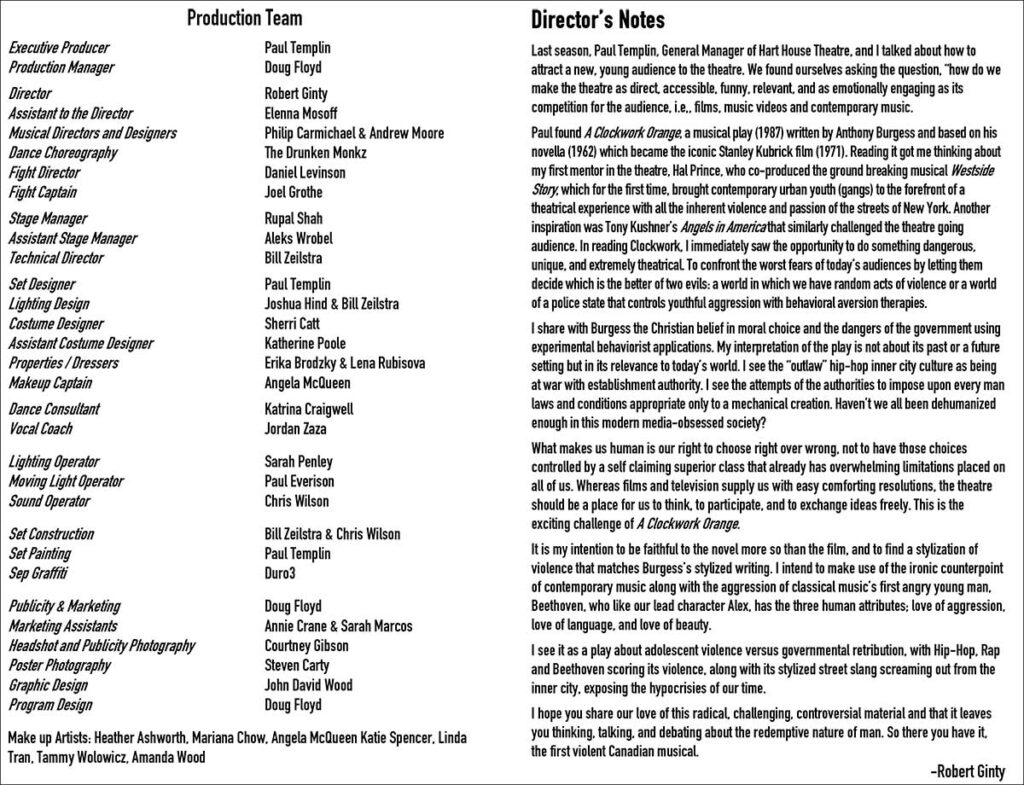
The Varsity Review
For another perspective on the production, check out the Sept. 20, 2004 review by The Varsity, which offered its own memorable assessment of Bishop Brigante’s performance: “Whichever way you cut it, one fact remains true of Bishop’s performance: it has way more street cred than P. Diddy’s attempt in A Raisin in the Sun on Broadway did.” The Varsity has been the University of Toronto’s student newspaper since 1880.
5 Ways to Support HipHopCanada:
- Submit Your Music
- Follow Canadian Fresh (HipHopCanada’s Spotify Playlist)
- Follow us on Instagram
- Follow us on X (Twitter)
- Like us on Facebook