




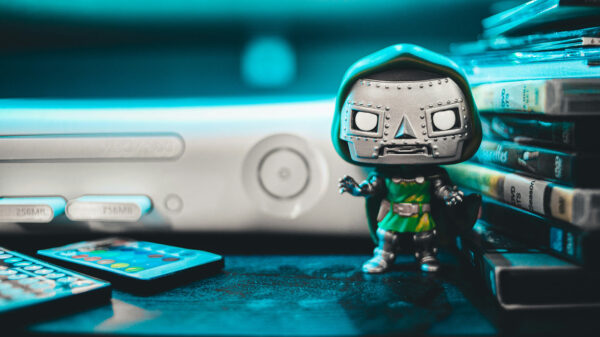


Doctor Doom, Marvel comics’ greatest supervillain, is finally coming to the Marvel Cinematic Universe (MCU) later this year in Avengers: Doomsday. As moviegoers will soon discover, he’s a megalomaniac dictator who believes his genius is the only way to save the world – and the evidence suggests he might be right.
Doom is going to be played by Robert Downey Jr, who previously helped launch the MCU as Iron Man. Fans have spent the past two years speculating how he can be both characters, with all sorts of theories flying around. It looks like the answer is going to lie in the multiverse, where multiple versions of characters can be played by different actors.
Doctor Doom first appeared in Fantastic Four #5 in 1962. He was so popular with readers that he quickly made his way across the expanding Marvel story world to menace Spider-Man, Daredevil, Iron Man and many others. These heroes were determined to try and stop him from taking over the world. Although they were usually successful, on the few occasions where Doctor Doom won, he tended to make a pretty good job of it.
For example, in the Emperor Doom graphic novel from 1987, Doom takes over the world by hypnotizing the delegates of the United Nations and getting them to vote him in as their new leader. He then solves world hunger, ends all poverty, abolishes apartheid and stops the nuclear arms race. Only for the Avengers to band together, overthrow him and put everything back as it was, all in the name of freedom.
“The world isn’t perfect,” says Captain America, as millions of people face starvation again, “but people are free to make their own choices.”
For someone unfamiliar with the genre this may seem odd, but it’s simply how superhero storytelling works. While conventional western stories are about a hero who goes out into the world, causes change and is changed by their own actions, in superhero stories it’s the job of the villain to try to change things, with the heroes dedicated to preserving the status quo.
This is partly due to the history of sporadic distribution for American comics, where readers could never guarantee getting consecutive issues from their local newsstand. Creators could therefore not rely on their audience knowing what had happened previously. This meant stories existed in what philosopher Umberto Eco called an “oneiric climate”, unchanging and with only a hazy view of the past.
Superheroes and the status quo
My own research into Doctor Doom shows that he changed very little over the next two decades, despite improvements to the comic book distribution system.
Marvel have expanded their stories into a huge interlocking continuity, but if anything this made it even more important to maintain the overall status quo. With characters appearing in multiple series created by different creative teams over many years, as well as on more and more merchandising items, making permanent changes became too complicated to coordinate. This means any temporary alterations in one series would inevitably revert back to normal before too long in order to match the rest.
One way to get around this, and provide what Marvel’s late creative leader Stan Lee called “the illusion of change”, was in so-called “events”. These are big story-lines that take place across multiple series. For example, in 2015’s Secret Wars comic series, Doctor Doom saves the multiverse from an attack by alien space gods, merging bits of alternate versions of Earth into a new planet called Battleworld.
For the next few months most Marvel titles took place in this new continuity. That was until the superheroes banded together to overthrow Doom and, once again, put everything back to how it had been before.
That series is likely to be the source material for 2027’s Avengers: Secret Wars, the follow-up to Doomsday, which could cause confusion for some audiences. Fans of superhero comics are used to the idea that the status quo must be maintained at all costs, but movie fans have always been encouraged to root for the person who wants to change things, not the people trying to stop them.
That’s even more likely to cause confusion with Doctor Doom, because he’s already a very sympathetic character.
Hero or villain?
Born into a working-class Romani family in the fictional eastern European country of Latveria, young Victor von Doom was orphaned at an early age when his mother was killed as a witch, and his father was hounded to death by a local baron.
He then used his technological genius to wage guerrilla war on the ruling classes, before being offered a scholarship to the US. A lab accident led to him being expelled and after various adventures with black magic, he returned to Latveria, overthrew the government and set himself up as dictator for life.
This self-made origin makes Doom different from most of the superheroes we’re familiar with from movies. They tend to get their powers at birth (like Superman or Wonder Woman), through state funding (Captain America, Black Widow) or inherited wealth (Batman). It also makes him different from most of out our real-world political and commercial leaders, who often come from privileged backgrounds but use their power to benefit themselves, rather than the rest of us.
The people of Latveria certainly think they’re better off with Doctor Doom. They love him for his strong leadership, low taxation policy and because whenever he proclaims himself a genius and the only person who can save them, he’s usually right.
Early hints from the extra scenes in Avengers: Endgame: Encore suggest Doom might be gathering a team to save the MCU multiverse from some otherworldly threat, as in the original Secret Wars series. If so, that will require huge, often deadly, decisions that are likely to cause huge change for the MCU – decisions only an agent of change like Doom can make.
So could the release of Avengers: Doomsday lead to us all becoming Latverians, hankering for a real-world equivalent of Doctor Doom? If so, there’s certainly no shortage of candidates who think they’re geniuses and uniquely qualified to fix the world, but finding someone who can actually do it – and is as handsome as Robert Downey Jr – might be a bit trickier.
Written by Mark Hibbett, Head of Research Information Systems, University of the Arts London
This article is republished from The Conversation under a Creative Commons license. Read the original article.

5 Ways to Support HipHopCanada: