














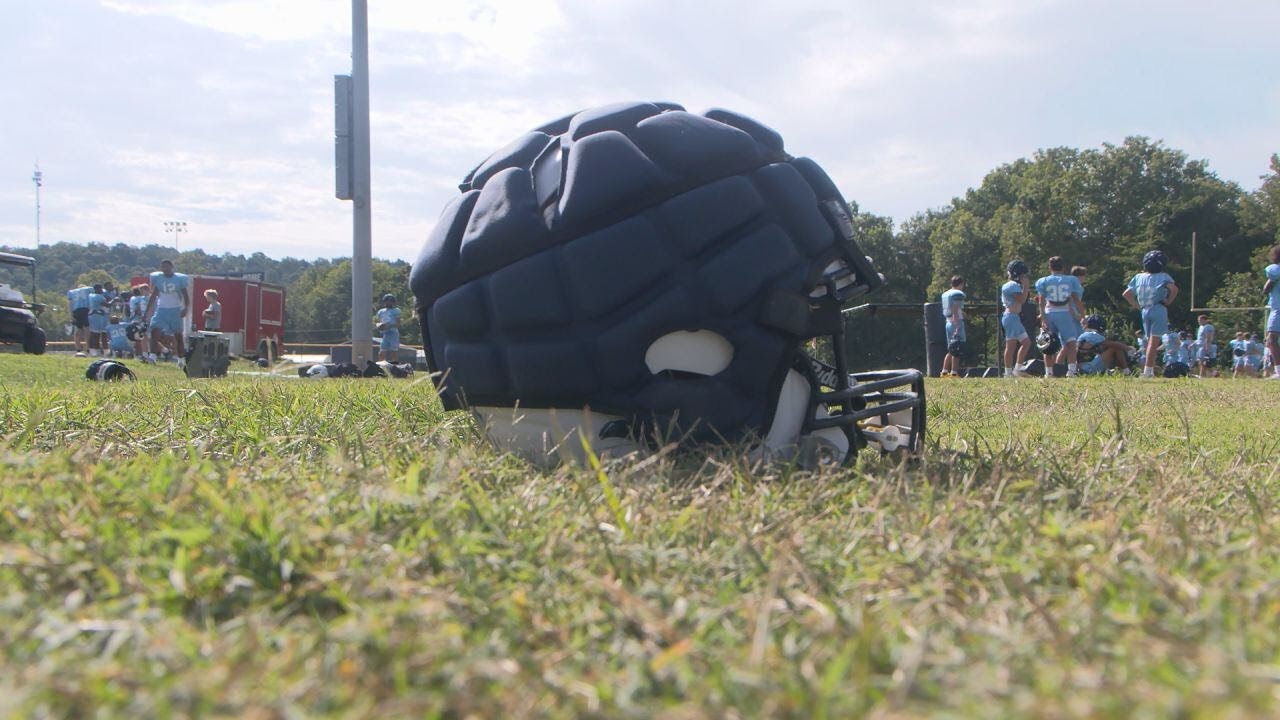

Fall brings football season in the U.S. and, with it, the parade of distinctively decorated helmets that the players wear.
Over time, the shape and size of these helmets have gradually changed, from the leather head coverings of the early 20th century to the space-age plastic domes we’re accustomed to seeing today.
But the visual profiles of some NFL football helmets may change drastically in 2024. The league has approved the in-game use of padded helmet accessories known as Guardian Caps, which, according to the NFL, “can reduce the force from head contact” by up to 20%.
A backlash has already begun. Some players have complained that the devices are unwieldy. And both fans and players have blanched at how the blocky accessory makes players’ heads seem disproportionately large.
Because I’m working on a cultural history of the football helmet, I’m eager to see what transpires.
In a multibillion-dollar sport in which the helmet is the preeminent branding space and symbol of the game, what happens when the imperative of player safety conflicts with its visual appeal?
We’re about to find out.
From the practice field to the playing field
Affixed to the outside of players’ existing helmets via snaps and Velcro straps, Guardian Caps consist of a series of soft, rectilinear pads connected by fabric.
After the caps were introduced in 2010, some college and pro teams gradually adopted them during practices. In 2022, the NFL began requiring their use in preseason practices. At first, only linemen and linebackers were required to wear them. By 2024, the league mandated all players except quarterbacks and kickers wear them while practicing. In April 2024, the league announced that players could wear them in regular season games at their discretion.

There seems to be good reason to encourage their use. Using data collected from all 32 teams, the league found that the devices reduce the impact force of head-on-head collisions by 20% when both players involved wear the device, and 10% when one of the players is wearing one.
Some scholars have expressed skepticism toward the NFL’s closely held research data. Nonetheless, the league claims that there’s been an eye-popping decline of 52% in concussion incidence reporting during preseason practices since the devices were mandated.
Touting the safety benefits of the Guardian Caps is an obvious public relations win for the NFL. Ongoing research into chronic traumatic encephalopathy, or CTE, and other traumatic brain injuries continues to show just how much damage repeated blows to the head can do to the brain, with football players particularly vulnerable.
Many players have supported the league’s efforts to put safety first, including Indianapolis Colts running back Jonathan Taylor, who became the first high-profile, skill-position player to wear a Guardian Cap during a preseason game on Aug. 11, 2024.
Guardian Caps – Players object
But the story of Guardian Caps’ introduction is not an unfettered success – at least, not yet.
Though the standard-issue Guardian Caps weigh less than 7 ounces (0.2 kilograms), many players find them heavy and hot.
“I hate them,” Seattle Seahawks defensive tackle Jarran Reed told The Seattle Times. “I understand the safety for them, but I’ve been playing a long time. It just looks crazy to me. I don’t like them. I’m ready to take them off.”
“I can’t stand them. It impacts my swag,” Philadelphia Eagles cornerback Darius Slay told CBS Sports. “My game is part of my swag. If I ain’t looking the part, I can’t feel the part.”
Obviously, in such a fast-paced and violent game, the tiniest margins – both physical and psychological – can make a difference in performance. And players like Reed, Slay and at least a dozen others don’t seem to be willing to sacrifice their ability to maximize on-field performance for incremental safety gains.
As important as such players’ objections to the feel and look of Guardian Caps may be, it may not be the most significant problem the NFL faces in their adoption.
Blemishing the brand
Simply put, many fans think the Guardian Caps are ugly, even when they’ve been covered with fabric that mimics the look of the logos on the underlying plastic shell.
But why should the reaction of the fans matter? After all, they’re not the ones putting their health on the line.
What’s more, for the first 75 years of football history, most helmets were nondescript. Per football historian Timothy P. Brown, early helmets were constructed from plain leather in “various shades of brown or black, so they all looked more or less alike, as did many team uniforms.” It wasn’t until the 1940s and ’50s, when sports equipment manufacturer Riddell’s early plastic models began to gain popularity, that the helmet’s potential as a canvas for decoration began to be realized.
Yet so much of the NFL’s incredible success is premised on its visual appeal.
In the early 1960s, then-NFL Commissioner Pete Rozelle observed that television, not ticket sales, would power football’s future financial success. Helmet branding was a vital way to promote and celebrate an NFL team’s identity. For TV viewers, helmet logos would become only more crisp and colorful as broadcasting technology improved.
Today, the logos that first appeared on helmets in the mid-20th century have become the icons of multibillion-dollar brands with hundreds of millions of fans around the world.
The negative impact the Guardian Caps have on the look of the game, and the importance of that look to the continued popularity of the game, have not gone unnoticed.
“Football is an extremely visual sport,” Mike Florio of Pro Football Talk wrote. “It thrives in large part because of how it looks on TV.”
“With sleek helmets coated in clumpy coverings that look like soundproofing panels, the vibe will be compromised,” he added.
Fortunately for Florio and others who dislike the look of the Guardian Cap, the NFL has already approved and encouraged the use of six new helmet models that purportedly provide equivalent protection to those with the Guardian Cap affixed to them.
These models don’t exactly look like normal helmets, either. But they don’t look like Guardian Caps, and that could make all the difference.
Written by Noah Cohan, Assistant Director of American Culture Studies, Arts & Sciences at Washington University in St. Louis
This article is republished from The Conversation under a Creative Commons license. Read the original article.