














Google, Microsoft and others boast that generative artificial intelligence tools like ChatGPT will make searching the internet better than ever for users. For example, rather than having to wade through a sea of URLs, users will be able to just get an answer combed from the entire internet.
There are also some concerns with the rise of AI-fueled search engines, such as the opacity over where information comes from, the potential for “hallucinated” answers and copyright issues.
But one other consequence is that I believe it may destroy the US$68 billion search engine optimization industry that companies like Google helped create.
For the past 25 years or so, websites, news outlets, blogs and many others with a URL that wanted to get attention have used search engine optimization, or SEO, to “convince” search engines to share their content as high as possible in the results they provide to readers. This has helped drive traffic to their sites and has also spawned an industry of consultants and marketers who advise on how best to do that.
As an associate professor of information and operations management, I study the economics of e-commerce. I believe the growing use of generative AI will likely make all of that obsolete.
How online search works
Someone seeking information online opens her browser, goes to a search engine and types in the relevant keywords. The search engine displays the results, and the user browses through the links displayed in the result listings until she finds the relevant information.
To attract the user’s attentions, online content providers use various search engine marketing strategies, such as search engine optimization, paid placements and banner displays.
For instance, a news website might hire a consultant to help it highlight key words in headlines and in metadata so that Google and Bing elevate its content when a user searches for the latest information on a flood or political crisis.
How generative AI changes search process

But this all depends on search engines luring tens of millions of users to their websites. And so to earn users’ loyalty and web traffic, search engines must continuously work on their algorithms to improve the quality of their search results.
That’s why, even if it could hurt a part of their revenue stream, search engines have been quick to experiment with generative AI to improve search results. And this could fundamentally change the online search ecosystem.
All the biggest search engines have already adopted or are experimenting with this approach. Examples include Google’s Bard, Microsoft’s Bing AI, Baidu’s ERNIE and DuckDuckGo’s DuckAssist.
Rather than getting a list of links, both organic and paid, based on whatever keywords or questions a user types in, generative AI will instead simply give you a text result in the form of an answer. Say you’re planning a trip to Destin, Florida, and type the prompt “Create a three-day itinerary for a visitor” there. Instead of a bunch of links to Yelp and blog postings that require lots of clicking and reading, typing that into Bing AI will result in a detailed three-day itinerary.
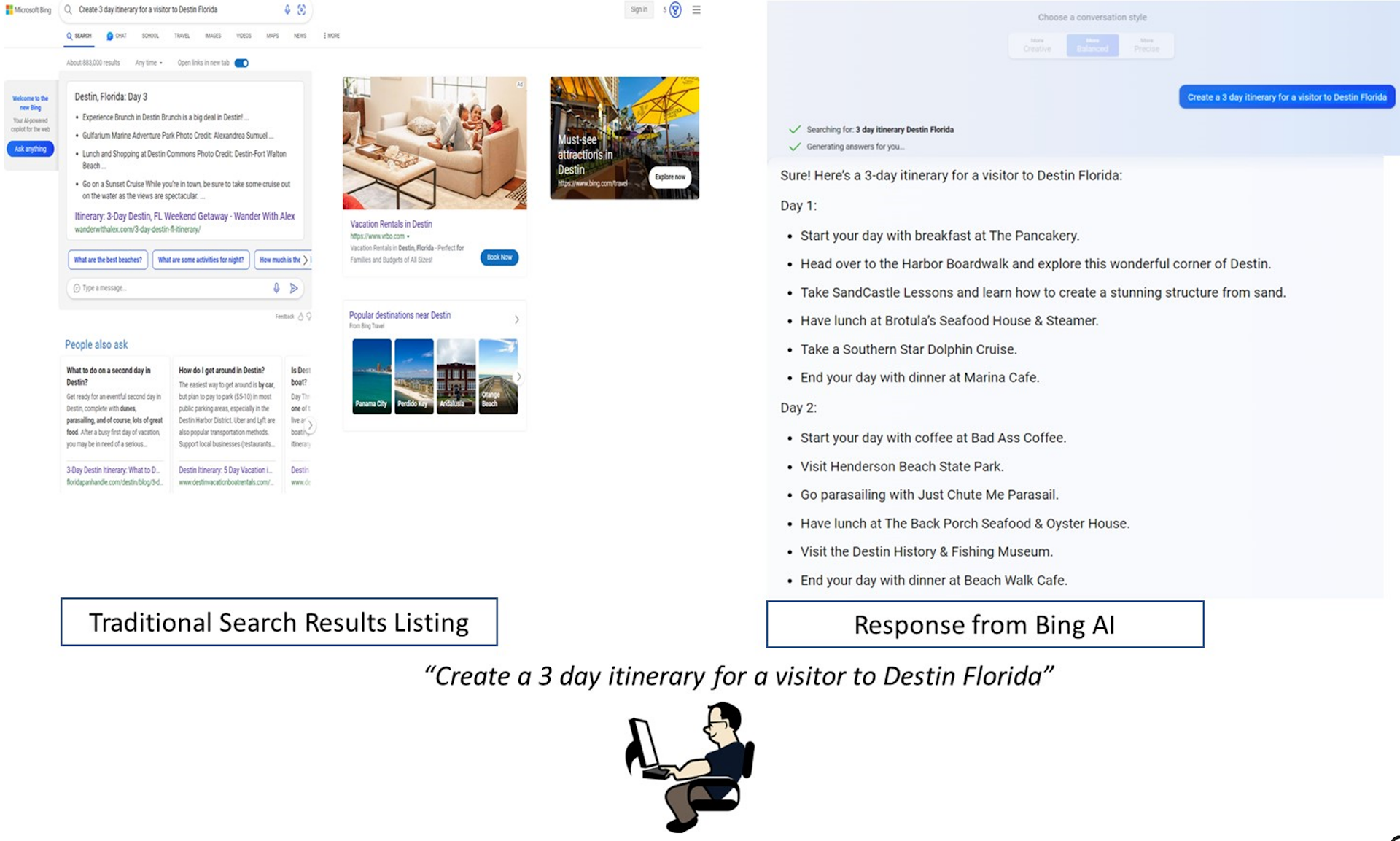
Side-by-side comparison of search results in regular Bing and the AI version from the prompt: ‘Create a 3-day itinerary for a visitor to Destin Florida.’
Over time, as the quality of AI-generated answers improve, users will have less incentive to browse through search result listings. They can save time and effort by reading the AI-generated response to their query.
In other words, it would allow you to bypass all those paid links and costly efforts by websites to improve their SEO scores, rendering them useless.
When users start ignoring the sponsored and editorial result listings, this will have an adverse impact on the revenues of SEO consultants, search engine marketers consultants and, ultimately, the bottom line of search engines themselves.
The financial impact
This financial impact cannot be ignored.
For example, the SEO industry generated $68.1 billion globally in 2022. It had been expected to reach $129.6 billion by 2030, but these projections were made before the emergence of generative AI put the industry at risk of obsolescence.
As for search engines, monetizing online search services is a major source of their revenue.
They get a cut of the money that websites spend on improving their online visibility through paid placements, ads, affiliate marketing and the like, collectively known as search engine marketing. For example, approximately 58% of Google’s 2022 revenues – or almost $162.5 billion – came from Google Ads, which provides some of these services.
Search engines run by massive companies with many revenue streams, like Google and Microsoft, will likely find ways to offset the losses by coming up with strategies to make money off generative AI answers. But the SEO marketers and consultants who depend on search engines – mostly small- and medium-sized companies – will no longer be needed as they are today, and so the industry is unlikely to survive much longer.
A not-too-distant future
But don’t expect the SEO industry to fade away immediately. Generative AI search engines are still in their infancy and must address certain challenges before they’ll dominate search.
For one thing, most of these initiatives are still experimental and often available only to certain users. And for another, generative AI has been notorious for providing incorrect, plagiarized or simply made-up answers.
That means it’s unlikely at the moment to gain the trust or loyalty of many users.
Given these challenges, it is not surprising that generative AI has yet to transform online search. However, given the resources available to researchers working on generative AI models, it is safe to assume that eventually these models will become better at their task, leading to the death of the SEO industry.
Written by Ravi Sen, Associate Professor of Information and Operations Management, Texas A&M University
This article is republished from The Conversation under a Creative Commons license. Read the original article.