







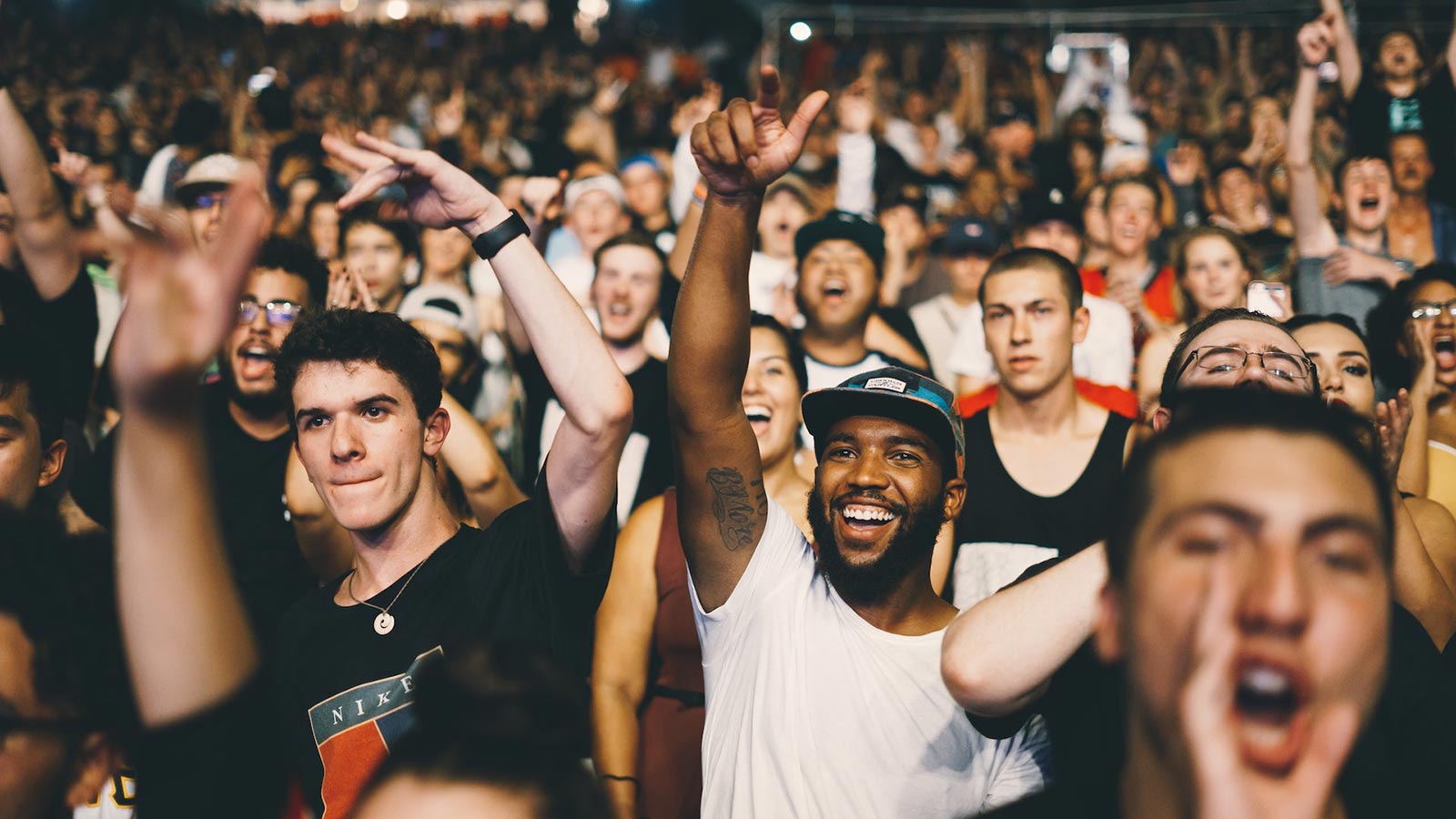

It’s that time of year again. The wellies are being dusted off, the tents aired and bags packed in anticipation of the many music festivals that will be happening this summer.
While music festivals offer a fantastic opportunity to see your favourite artists and bands back-to-back, listening to so much loud music for many hours can put your hearing at risk of damage. Luckily, taking just a few simple precautions can help protect your hearing – allowing you to enjoy the festival scene now and for years to come.
We’ve only got one pair of ears to last us a lifetime – so we need to protect their delicate machinery from damage. One part of our ears that’s particularly delicate are the hair cells located in the cochlea (a tiny fluid-filled organ in the inner ear that turns vibrations into nerve impulses). These microscopic hairs can be damaged by loud noise exposure – and this damage is irreversible.
The key factor in whether or not our ears get damaged by loud noise is the “dosage” of noise you’re exposed to. Dosage is compromised of two components: the intensity and duration of the sound.
Hearing and sound intensity
Sound intensity is measured using the decibel scale (dB), which relates the intensity of sound to the quietest sound we can hear. It’s a logarithmic unit, which means an increase of 3dB equates to a doubling of sound energy and intensity. So an 88dB sound is twice as intense as an 85dB sound.
Sound intensity is not something we can easily measure without equipment – so be careful with smartphone apps as they’re often not accurate. But if you have to shout to be heard by someone two metres away (the so-called “shout” test), the sound is probably loud enough to be a potential risk.
The second factor is duration, which is much easier for us to determine.
For context, UK occupational noise exposure guides deem it acceptable to be exposed to an 85dB sound (equivalent to a food blender running) for about eight hours a day, five days a week.
Using this information alongside what we know about sound intensity, we can determine how long we’re safe to be exposed to other sound intensities. Since each 3dB increase in sound intensity halves the acceptable exposure time, that means an 88dB sound (equivalent to the sound of heavy traffic) would thus be acceptable for four hours. A 91dB sound would be acceptable for only two hours.
The UK Health and Safety Executive recommends that, at festivals and concerts, the sound intensity does not exceed 107dB anywhere in the audience area. This would be a level “safe” to listen at for around 2-3 minutes.

Event organizers are also advised to give public warnings if levels are expected to exceed 96dB. Assuming this level is met, this gives a “safe” duration of around 30 minutes to one hour.
So with the potential risks posed, here’s what you can do this festival season to care for your hearing:
1. Take regular breaks
In the same way someone working in a noisy environment would take regular breaks, you should also try to take breaks from the noise where you can. Find a quiet spot between sets so you can give your ears a rest.
There’s no hard and fast rule for how long or how often you should take breaks. But if your hearing feels dulled or you hear ringing or buzzing (tinnitus) you’ve probably already overwhelmed your ears and should take a break.
2. Protect hearing by wearing ear protection
This advice is especially sensible during multi-day festivals. Anything from universal foam earplugs through to custom-fitted musicians’ earplugs can be helpful.
But when exploring your options, keep a couple things in mind. First of all, you don’t actually need to buy a high-strength earplug, as this may compromise how well you can enjoy the music. Remember, just a 3dB drop in intensity doubles exposure time. So assuming a 94dB average sound level, 3dB plugs would extend “safe” listening time for two hours. Earplugs that are rated to 6dB would extend listening time to four hours.
But do use a commercial product, and definitely not improvised earplugs (such as cotton wool, which does very little apart from generating funny looks). Commercial products should be proven to block noise when fitted properly.
Hearing protection is particularly important for children, as evidence shows they may have a lower threshold for “safe” exposure. It’s recommended children use hearing protection at all times when listening to loud music. They should wear hearing protection which completely covers their ears (ear defenders).
3. Keep your distance
Sound waves obey the inverse square law. By doubling your distance from the source (speaker), the intensity drops four times (so 6dB) – quadrupling safe listening time.
If you’ve given your ears a bit of a hammering, dropping back in the crowd for a song or two can have a big effect on your exposure. You should also never be closer than 3m to a speaker.
4. Watch how much you drink
Some evidence shows that alcohol makes us less sensitive to loud sound (though our ears can still be damaged by it). This means that as the day goes on (depending on the amount you’ve indulged), you may be less aware of how loud the music is – and may not move away or take a break when needed.
Evidence also suggests that alcohol consumption can make the ear more susceptible to noise damage itself. This may especially be true for people who have a flushing reaction (face redness) when drinking alcohol.
We don’t yet fully understand the effect of alcohol here but there is enough to suggest some awareness is a good idea, along with situating yourself farther from the stage and wearing earplugs.
The old adage of everything in moderation remains valid here. Taking sensible precautions means you can enjoy music festivals now and for years to come.
Written by Robert MacKinnon, Clinical Scientist and Deputy Head of School, Anglia Ruskin University
This article is republished from The Conversation under a Creative Commons license. Read the original article.