










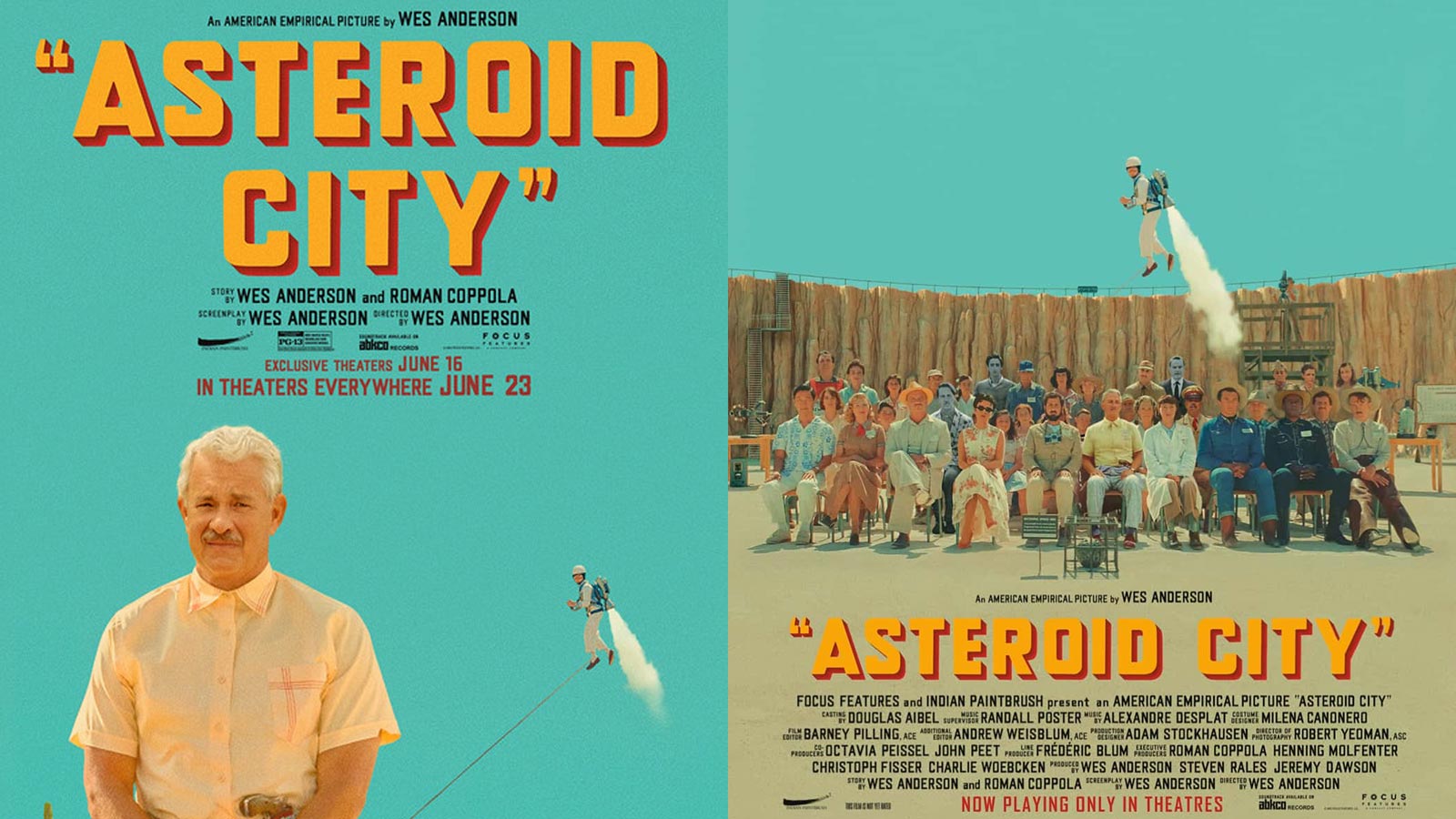

Wes Anderson’s new film Asteroid City (2023) is a sci-fi dramedy following a grieving family stranded in a rural US town during a star-gazing event in the summer of 1955.
However, it’s also a text by fictional playwright, Conrad Earp (Edward Norton), the writing and dramatisation of which forms the basis of this film’s framing story. And those hyper-saturated, expansive vistas you’re likely to be familiar with from the film’s promotional materials are from the in-world, televised dramatisation of this play.
You’re right, it’s confusing.
This is a story within a story within a story where art mimics art. Anderson is obsessed with these types of framing devices. His last feature, The French Dispatch (2021) has an anthology structure, with each story representing an article in an issue of the film’s fictional Liberty, Kansas Evening Sun newspaper.
I’ve also written about how The Life Aquatic with Steve Zissou (2004) often visually resembles the faux documentaries made by the faux oceanographic collective, Team Zissou, as if you’re watching something which could have been created within the plot of the film itself.
Even as far back as The Royal Tenenbaums (2001), Anderson depicted his film as a realisation of a fictional book, splitting it into chapters and including a prologue and epilogue. The effect of these framing devices has increasingly created a sense of distance, as if the director is making a concerted effort to hold the viewer at arm’s length. It often means the viewer can appreciate, but never feel wholly invested in, the events onscreen.
Despite taking a similar approach to framing its story, Asteroid City is by far the most engaging Anderson film in a decade. It’s sumptuous to look at, with a raw emotion consistently threatening to leak out from behind its perfectly composed frontispiece.
The control of these emotions, oscillating between the now-expected deadpan posturing and fleeting moments of cathartic release, has always been an ace up Anderson’s sleeve. It can be found in The Darjeeling Limited (2007) scene where the Whitman brothers let go of their luggage to catch a moving train at the film’s climax. It’s there when Steve Zissou is reduced to tears asking, “I wonder if it remembers me?” as he comes face-to-face with the shark that murdered his friend in The Life Aquatic.
And it is present in Asteroid City in a handful of sequences towards the film’s end, which I won’t spoil, but that are the beating heart of a picture that otherwise contains all the typical quirks and occasionally suffocating authorial flourishes one might expect from an Anderson project.

Star turns
The film moves from a small 1.37 black-and-white aspect ratio to widescreen colour as it follows the different stories. In these widescreen shots, Asteroid City returns to the pastel colours that could be considered one of the hallmarks of Anderson’s work. The sparse, barren setting of the film is rendered vibrant by Anderson’s regular cinematographer, Robert Yeoman.
The small desert town resembles a live-action incarnation of a Looney Tunes cartoon. Anderson directly acknowledges the cartoon’s influence by including a roadrunner bird dancing along to the film’s soundtrack in one sequence.
As always, the film boasts a gargantuan cast, which is impressive even by Anderson’s standards. There are some first-timers (Margot Robbie, Tom Hanks) appearing alongside familiar faces (Willem Dafoe, Tilda Swinton and Jeff Goldblum).
It is a particular pleasure to see Jason Schwartzman in a leading role a quarter-century after his breakout performance in Anderson’s Rushmore (1998). Schwartzman plays Augie Steenbeck, a war photographer and the unwilling patriarch of the film’s central family.
But it is Scarlett Johansson who steals the show as Midge Campbell, a famous actress also stranded in Asteroid City after a mysterious incident places the town’s inhabitants under a strict and indefinite quarantine. Johansson expertly tows the line between playing up the blank delivery that is often required of lines in Anderson screenplays and the lively curiosity of someone who might exist in our reality – someone interested in a life beyond her immediate surroundings.
As events take a cosmic turn, the wheels occasionally threaten to come off. However, the film is buoyed by some wonderfully understated comic performances from Steve Carell and Liev Schreiber, as well as 50s-inspired original music by British musicians Jarvis Cocker (also starring) and Richard Hawley.
Asteroid City contemplates grief, the unknown and the way these things can be rendered meaningful through art – in photography, a play and, in a self-reflexive turn, even this film. In the moment, it’s a surprisingly breezy affair packed with ideas that linger in the hours and days after first watching.
Written by Tom Hemingway, Teaching Fellow in Film and Television Studies, University of Warwick
This article is republished from The Conversation under a Creative Commons license. Read the original article.