







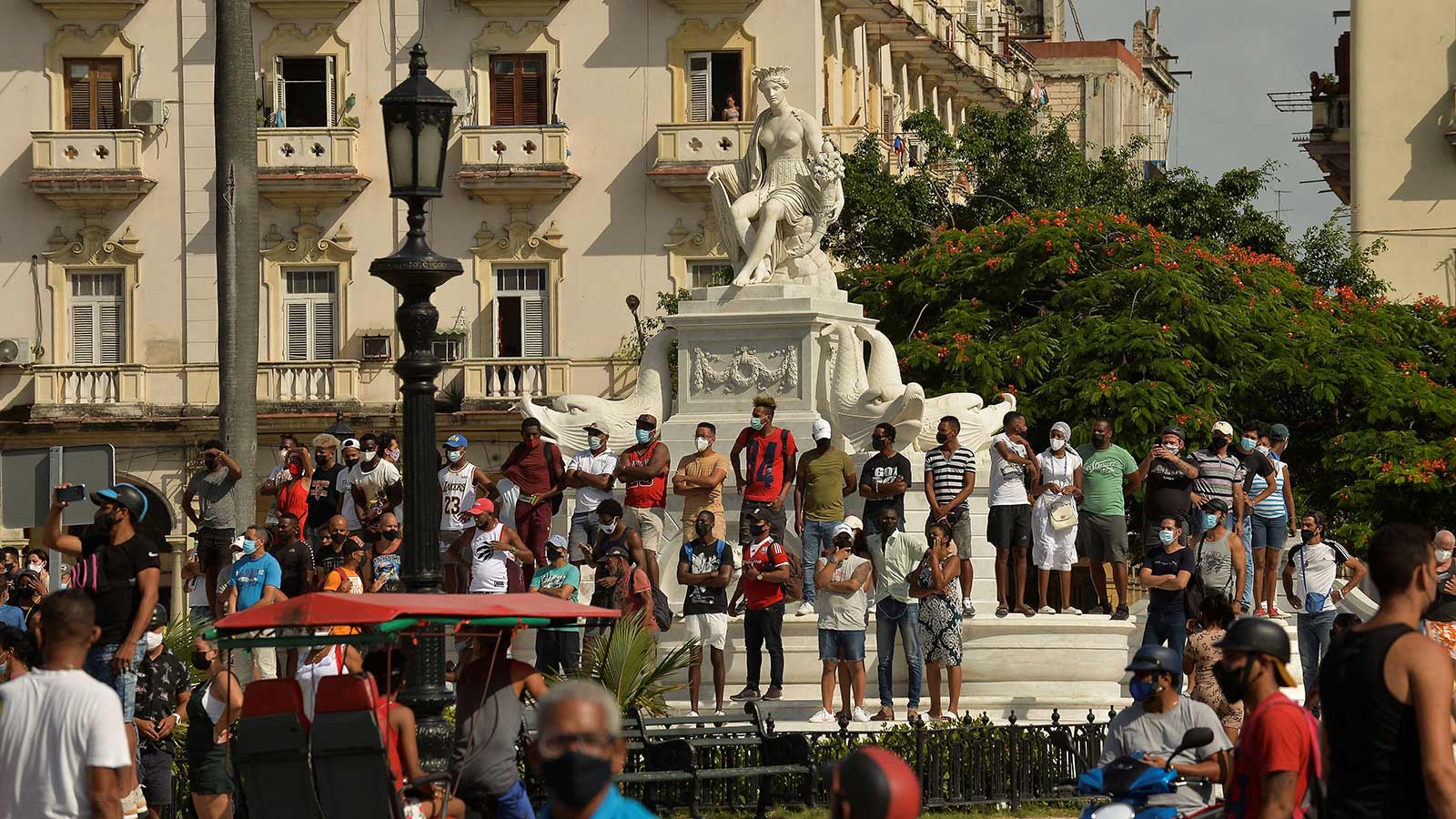

Street protests erupted across Cuba on July 11, 2021, with crowds of Cubans demonstrating against food scarcity, medicine shortages and economic misery in their island nation. Some demanded “freedom” and the end of “dictatorship” – anti-government sentiments that were soon echoed in the United States by Cuban-Americans and politicians, including President Joe Biden.
Related
- Tory Lanez calls for support of Cuban people during ongoing protests
- ‘Patria y Vida’: The Dissident Rappers Helping Drive Cuba’s Protests
- How ‘Patria Y Vida’ Became the Anthem of Cuba’s Protests
In a televised address, Cuban President Miguel Díaz-Canel blamed the spontaneous demonstrations – by far the largest mass protests in decades – on U.S. interference and threatened a “battle in the streets.” Protesters say hundreds were arrested.
These four stories describe current conditions in Cuba and the recent history behind this rare public outpouring of anger.
2018: Cuba gets a new president
The Communist Party has run Cuba since the 1959 Cuban Revolution.
For five decades, its leader was the fiery, anti-American revolutionary Fidel Castro. Castro led the country until 2008, when he fell sick and was succeeded by his more subdued younger brother, Raúl.
The younger Castro, also a Cuban Revolution fighter, maintained the his party’s total grip on politics but liberalized Cuba’s Soviet-style economy, recognizing private property and allowing Cubans to run small businesses. He also cultivated a less antagonistic relationship with the United States during the Obama administration.
Raúl Castro’s April 2018 retirement marked the end of the revolutionary era. But the selection of Díaz-Canel as president in April 2018 seemed unlikely to herald the beginning of a new Cuba.
“I don’t expect any drastic changes in direction from Díaz-Canel – at least, not right away,” wrote the American University Cuba analyst William LeoGrande shortly after Diaz-Canel took office.
Díaz-Canel is a seasoned Communist Party insider and Raul Castro’s chosen successor. Castro also remained in Cuba’s government until 2021 as first secretary of the Communist Party, “arguably a post more powerful than the presidency,” says LeoGrande. Díaz-Canel came into office facing serious problems, including a weak economy and bad relations with the U.S. under then-President Donald Trump.
He also faced a new challenge: the internet, which had just become widely available to everyday Cubans. Access to online information and social media makes it harder for Díaz-Canel to repress dissent as effectively as for his predecessors.
“Internet expansion on the Communist island has produced a growing chorus of domestic critics,” LeoGrande wrote.
2019: Cuba gets a new constitution
Those critics gained more leeway to show their discontent in February 2019, when the Cuban National Assembly passed a new Cuban Constitution.
It included provisions that would “substantially expand social, political and economic rights in Cuba,” wrote the Cuban-American scholar María Isabel Alfonso.
One of those rights was freedom of assembly.
“Previously, Cubans had the ‘right to meet, demonstrate and associate, for licit and peaceful purposes,’” explained Alfonso, “but only as part of a so-called ‘organización de masa’ – the Cuban term for state-run groups.”
The new constitution removes the ‘organizaciones de masa’ restriction, theoretically giving people and civil society groups more freedom to gather.
But Alfonso cautioned that the government could still crack down on “independent organizations – especially if those groups are political in nature.” In her Feburary 2019 article, she quotes the Cuban blogger José Gabriel Barrenechea saying that, in Cuba, “spontaneous gatherings are not seen positively and are always perceived to be the product of a foreign power.” Among other changes, Cuba’s 2019 Constitution also gave constitutional legitimacy to Raúl Castro’s economic reforms and limited Cuban presidents to two five-year terms.
2020: Artists revolt
Cuba’s new Constitution reflects how Díaz-Canel has largely followed his mentor Raúl Castro’s path of gradually giving Cubans greater economic and social freedoms but resisting pressure for democratic reform.
One result of Castro’s 2009 move to legalize small businesses, for example, was a flourishing of activist art. As galleries and theaters opened across Cuba, enabling artists to show their work in nongovernment-run cultural spaces, “dissident artists took advantage of this newfound freedom to advance their political demands,” says Alfonso.
In 2018, the Díaz-Canel government issued a decree imposing restrictions on independent artistic production and cultural venues, angering many artists. Then, in November 2020, the government raided the home of an artist who openly opposed the government’s decree.
Cuban artists and intellectuals rebelled. Days after the raid, about 300 of them convened via WhatsApp to stage a protest outside the Culture Ministry. They demanded negotiations with the government to restore freedom of expression.
“The negotiations would end soon after they began, followed by a major crackdown on dissent,” wrote Alfonso. But “the size, duration and public nature of the artists’ opposition were unprecedented.”
The artists’ uprising was, she says, “a sign of how resistance in Cuba has grown and changed.”
2021: The Castro era ends
Raúl Castro stepped down from his top post in the Communist Party in April 2021, leaving behind a changed Cuba. It is no longer a Soviet-backed ideological challenger – or nuclear threat – to the United States. Bereft of international communist patrons and financially isolated from the world by the strict, decades-old U.S. embargo, Cuba is ailing.
For so long the bearded, fatigues-clad Fidel Castro defended the pain of the Cuban people as the righteous struggle of a proudly sovereign nation. Díaz-Canel, born in 1960, lacks Castro’s charismatic ability to invoke the faded revolutionary past.
Ever fewer Cubans even remember those heady post-revolution years, says the Cuba historian Joseph Gonzalez.
“Unlike their parents and grandparents, Cubans in their 20s, 30s and 40s never enjoyed a sustained, functional contract with the regime: We provide you a living, and in exchange you give us support, or at least acquiescence.”
Gonzalez says younger generations in Cuba still trust the government to provide free quality health care and education – both achievements of the Castro era.
“But they know it cannot feed, clothe and house its people in any but the most basic way,” he says.
Today, Cubans have to hustle to survive; many work two jobs. A recent currency change means cash is scarce and many everyday goods are unaffordable. And after a year keeping the pandemic largely at bay, COVID-19 is surging on the island.
Recent protests suggest some Cubans are sick of so much struggle.
Written by Catesby Holmes, International Editor | Politics Editor, The Conversation
This article is republished from The Conversation under a Creative Commons license. Read the original article.