











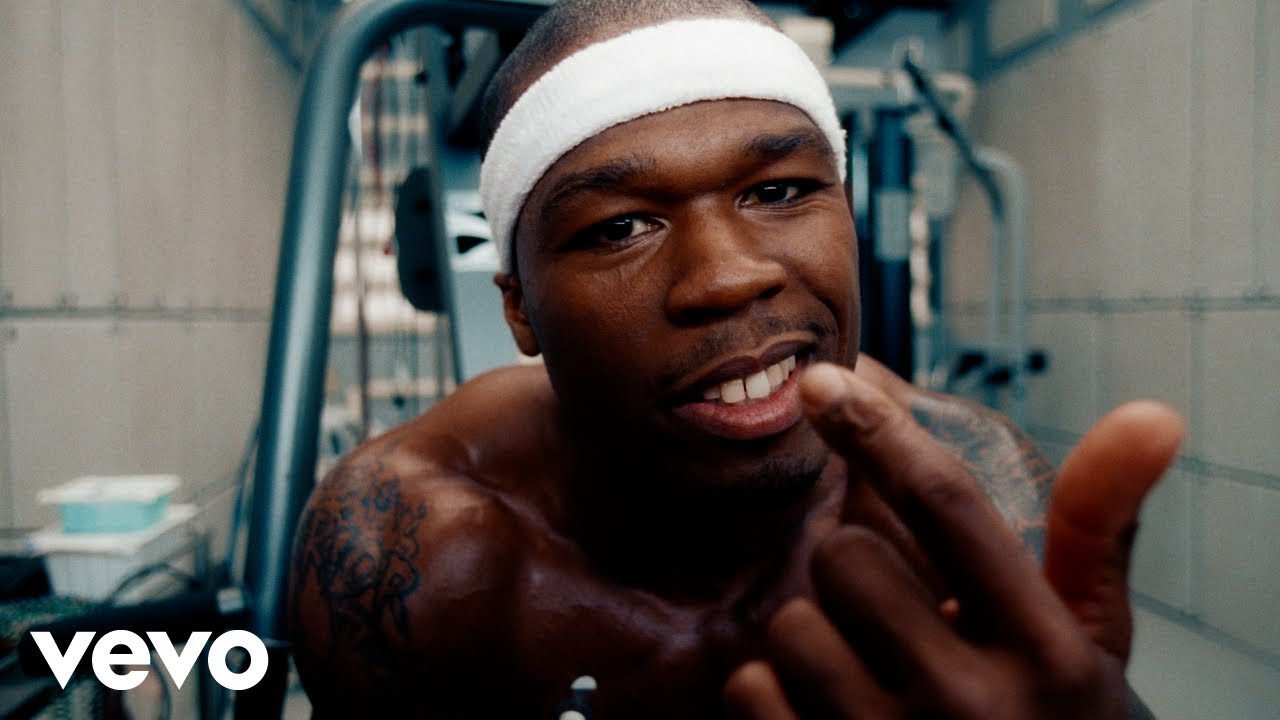

It is January 2003 – many years before I began researching popular music professionally – and I’m flicking around the music channels on TV. Disillusioned by the usual paint by numbers chart fodder and ready to call it a day, I chance upon the video for a new song called In Da Club by a rapper called 50 Cent.
The video shows a van driving through a desert on its way to the “Shady / Aftermath Artist Development Centre”, where lab coated rap legends Eminem and Dr. Dre observe a “patient” through a Perspex screen.
The patient in question looks like he’s just burst off the pages of a comic book. All bulging muscles, smouldering stares and chiselled good looks, he’s hanging upside down from a pull up bar as he performs eye-watering stomach crunches.
The message is clear: Dre and Eminem have created a hip-hop monster, a living embodiment of the threat and danger hip-hop had always flirted with. And in among it all, was an irresistibly infectious song.
This was back in the days when I’d be “in da clubs” myself and during the following months, two things were inevitable:
- 50 Cent’s song would be played at least twice every night.
- Each time, it would be accompanied by screams and stampedes to the dance floor.
In Da Club reached number one on the Billboard Hot 100 and by the time its parent album, Get Rich Or Die Tryin’, was released, Curtis “50 Cent” Jackson had achieved his aim of putting “the rap game in a chokehold“. Part of his success may be attributed to the backing of Eminem and Dre, but it was Jackson as an individual that provided the main draw.
50 Cent, listeners soon discovered, was an artist who possessed the authenticity so important to hip-hop. Jackson wasn’t just posturing about the “gangsta” lifestyle – he had the scars to prove it. Nine of them, to be precise, from a shooting in 2000.
Underprivileged youth with a tragic backstory? Check. Drug dealing past? Check. Spent time in prison? Check. Jackson had lived the life he rapped about.
Inadvertently his distinctive flow, a mumbling southern monotone caused by the aforementioned shooting (which left bullet fragments in his tongue) may even have spawned “mumble rap”, much as Jackson scoffs at the sub-genre.

The return of the ‘Gangsta’
Although “Gangsta rap” had been around for decades, by the time Jackson arrived on the scene in 2003 many big name rappers such as Nelly were making softer, pop-inspired hip-hop.
The release of Get Rich or Die Tryin’ brought back “hip-hop in its rawest form“. The album itself was styled to look as though the plastic cover had been shot, and the CD booklet contained a photograph of Jackson pointing a gun at the camera.
In his 2009 research on the importance of authenticity in Gangsta rap, professor of rhetorical studies, Erik K. Watts, observed: “One of the most meaningful accomplishments of gangsta artistry has been to open a window on the daily, gritty grind of inner city living.”
It would be hard to argue the case that Get Rich Or Die Tryin’ offers social commentary in the same way as a NWA’s Straight Outta Compton, or Kendrick Lamar’s To Pimp a Butterfly. But at the time of its release it was, as a BBC review explained: “The antithesis to the pop looped chart friendly sound of mainstream hip-hop.”
With Get Rich or Die Tryin’, 50 Cent brought back some much needed credibility to the world of commercial hip-hop.
Picking up the Cent
To those listening in English nightclubs, songs like In Da Club, P.I.M.P, and 21 Questions offered a glimpse into a culture that was thousands of miles away, both literally and metaphorically.
Sugar-coated as it was with catchy beats and melodies, 50 Cent’s music allowed audiences to observe, as Pitchfork described it: “the pull between community and wealth, morality and survival” that Gangsta rap focused on, away from the real danger the lyrics were discussing.
There was discomfort, watching white, middle class audiences singing along to songs that featured both misogynistic and homophobic slurs and the n-word. Race theory professor Michael Dyson has explained the phenomenon as a form of “voyeurism” that sometimes offered an excuse to express offensive views in a way that couldn’t be attributed to the individual singing them.
But from my perspective, standing awkwardly to the side of dance floors rather than on them, the impact this music could have on a group of people so far removed from the lifestyle the lyrics were presenting was impressive. Such is the power of music – and of 50 Cent’s unforgettable album.
Written by Glenn Fosbraey, Associate Dean of Humanities and Social Sciences, University of Winchester
This article is republished from The Conversation under a Creative Commons license. Read the original article.