


















TLDR: Military drones are transforming warfare through autonomy, AI, and swarm tech — reshaping how nations fight and who controls the skies.
Both Israel and Iran used drones in the strikes that began between the two countries in June. Israel introduced drones into Iran to hit targets, while Iran launched roughly 100 aimed at Israel.
Ukraine also recently carried out Operation Spider Web consisting of attacks by 100 drones deployed from air bases deep inside Russian territory. Ukraine destroyed several strategic bombers by transporting drones in civilian trucks.
These two examples show how the use of armed drones, although not new, is now growing. Drones have been used for more than a decade for reconnaissance or targeted elimination, but are now playing an increasingly significant role as combat units of their own.
I am a researcher working on armed conflicts (particularly the conflict between Ukraine and Russia) and the use of new technologies. Since automation and robotization in armed conflicts are vast topics, I will focus on how armed drones are changing the way wars are fought.
Fighting from long distances
Drones are devices that are traditionally controlled remotely, by an operator. In the case of military drones, the distances can now span the globe thanks to satellite control.
This combination of technologies allows drones to be controlled from operation centres located far from battlefields and combat zones. This keeps the drone “pilot” safe and minimizes human casualties among those using the technology. The main risk is the loss of connection with the drone: when it no longer receives instructions, it can be destroyed or captured by the enemy if they manage to hack the signal.
Two developments are changing this classic situation: the proliferation of miniature drones and automation.
The democratization and commercialization of small drones for the general public have opened up new possibilities in armed conflicts. Indeed, smaller drones are being produced and can be used on the battlefield. One example is the Switchblades used in Ukraine. These are suicide drones that cost less than $100,000, which is cheaper than a Javelin anti-tank missile.
But the conflict has pushed Ukrainian forces to innovate with an even cheaper and easier-to-use solution: commercial drones (or racing drones) sold to the general public that are modified to carry explosive charges. The cost per drone is in the hundreds of dollars.

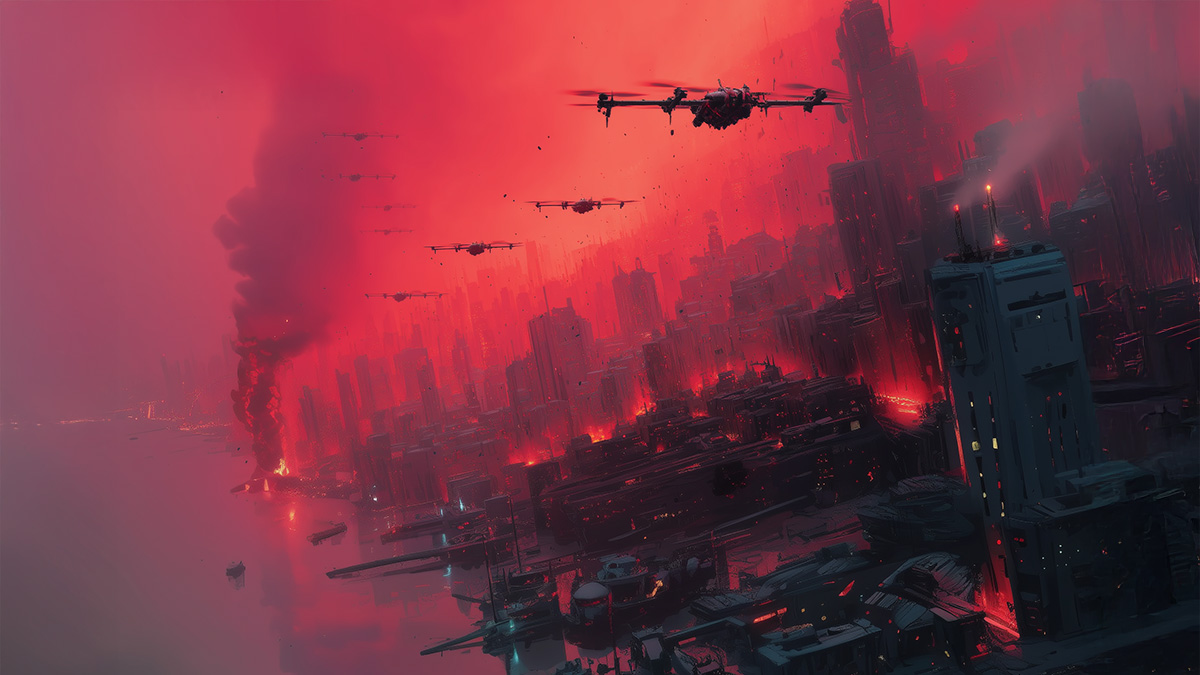
When equipment is lacking, this type of drone makes it possible to carry out guerrilla warfare and harass an enemy, particularly since these types of drones can be deployed in large numbers. However, they can only be used at short distances, so their operator remains vulnerable.
Towards increasing autonomy
The other trend is the automation of drones. Technological advances are enabling them to become more autonomous.
For the moment, we are seeing the development of semi-autonomous machines with a number of automated functions which do not require human intervention. However, they remain under human control.
A publication by Ariel Shapiro from the Canadian Parliament Library classifies the autonomy of drones according to three levels: the semi-autonomous system, in which a human operator authorizes the use of force; supervised systems, which operate independently but can be monitored and stopped by a human operator at any time; and fully autonomous systems, which, once launched or activated, no longer communicate with the human operator.
Semi-autonomous and supervised systems account for all drones currently in use. However, this level of autonomy remains advantageous and allows the devices to require less human supervision.
Drone swarms
The rise of drone swarms makes this autonomy increasingly useful.
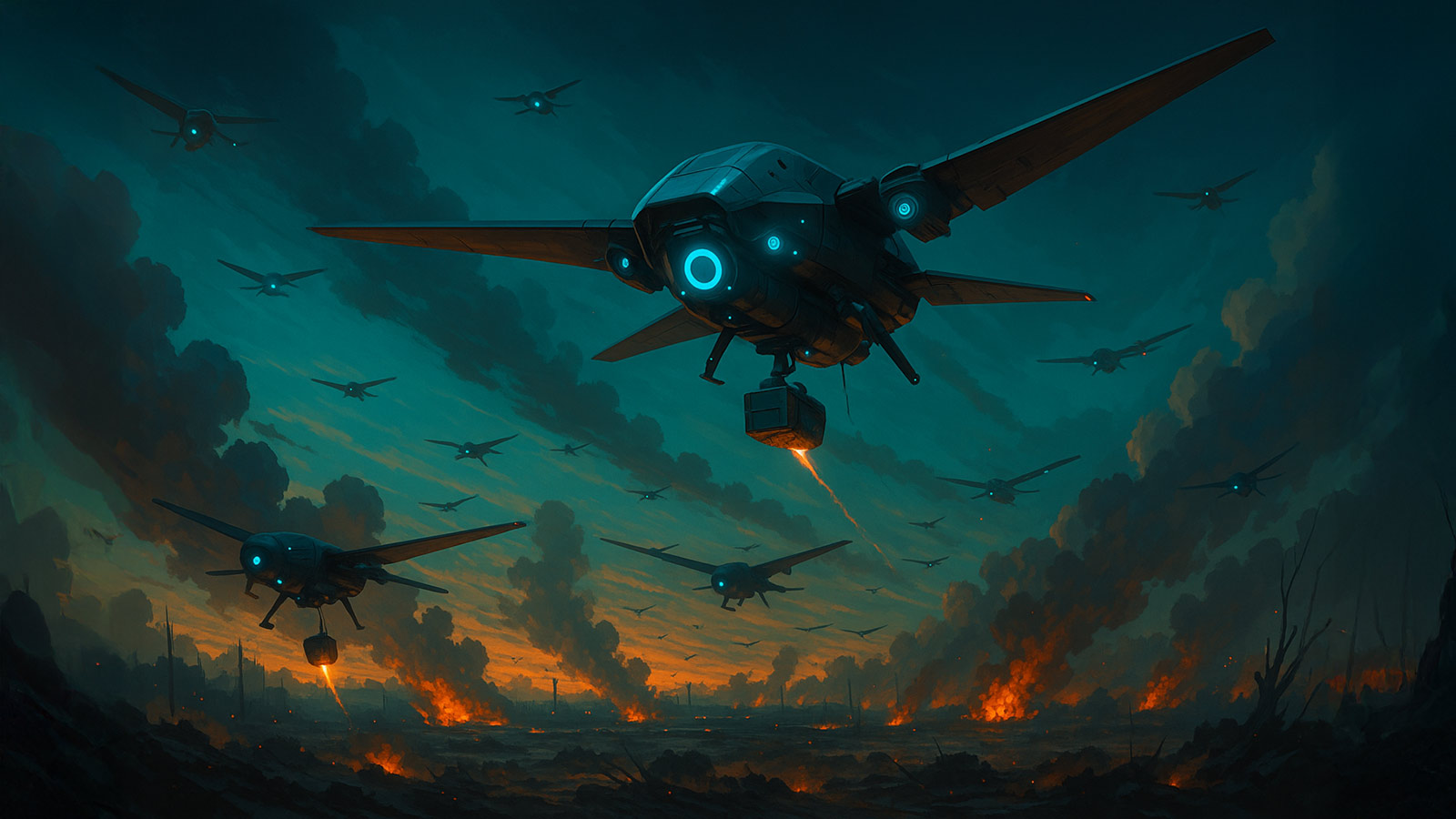
These swarms consist of groups of drones that operate in a co-ordinated manner while requiring only a small number of operators (who can control several drones or even the entire swarm). They can be used to saturate an area with their sheer numbers.
Meanwhile, advances in artificial intelligence are enabling the development of completely autonomous devices that no longer need a human operator to function. Known as lethal autonomous weapon systems (LAWS), these devices do not yet have a single definition. However, the United States Department of Defense defines LAWS as “a weapon system that, once activated, can select and engage targets without further intervention by an operator.”
This increasing automation has the advantage of providing machines that can make decisions more quickly than humans can, and that are more adaptable. However, this raises the question of human control over autonomous systems: they must remain under human control in some way to prevent them from behaving in a manner that is contrary to the desired objectives.
The global balance of power
Although the sensitive nature of weapons makes it difficult to ascertain the capabilities of each country, certain trends are emerging.
According to the Center for a New American Security (CNAS), the armed drone market was initially led by the U.S. and Israel. However, the last decade has seen the entry of new countries such as China, Turkey, and Iran based on the sale and export of drones.
However, when it comes to innovation and mass production of drones, only the U.S. and China seem to have the necessary resources and economic infrastructure. This is even more true when combined with artificial intelligence. According to a 2023 report by the European Parliament, 73 per cent of Large Language Models (LLMs, which are AI models) were produced in the United States and 15 per cent in China.
Written by Alexandre Massaux, Ph.D. in international relations, Université de Toulon
This article is republished from The Conversation under a Creative Commons license. Read the original article.