












TLDR: TV addiction takes centre stage in the 1988 Public Enemy protest track—a message that resonates stronger than ever in the digital age.
Originally published on March 19, 2018, this article by Adam de Paor-Evans feels even more relevant today, as much of society remains glued to their smartphones.
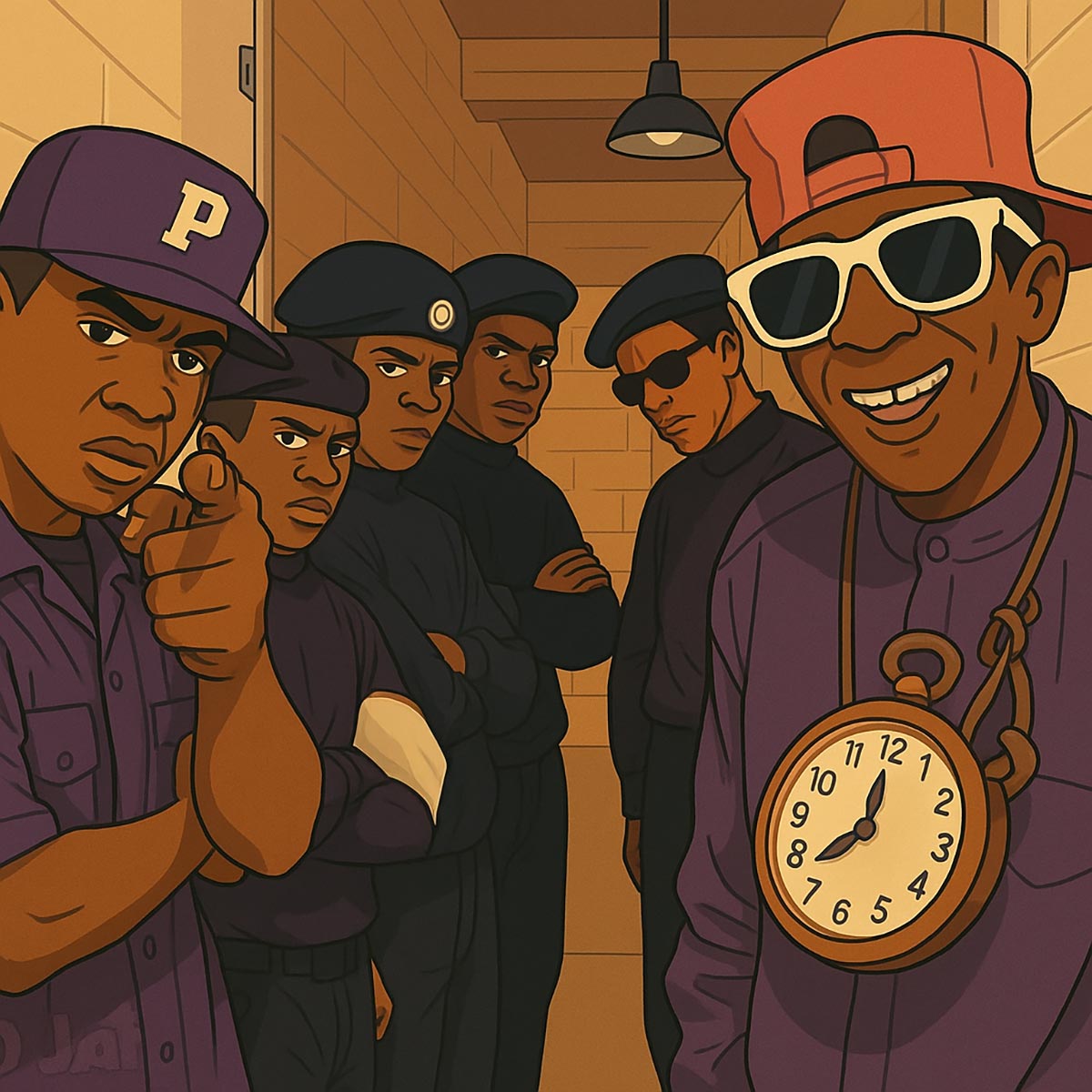
Veteran American hip-hop group Public Enemy need no introduction when it comes to paradigm shifts in that music genre. From the moment leader and rapper Chuck D, fellow rappers Flavor Flav and Professor Griff, group DJ Terminator X and the S1W group (aka Security of the First World) launched off the Def Jam record label’s platform in 1987, their acute sociopolitical presence resonated throughout hip-hop culture and far beyond.
With their debut album “Yo! Bum Rush The Show” (1987), it was clear that Chuck D’s lyrical pressure was destined to confront racism, destitution and a myriad of other issues connected with African American life.
However, the song I would like to discuss here is the lesser-celebrated “She Watch Channel Zero?!” from their 1988 sophomore album “It Takes A Nation Of Millions To Hold Us Back”. Dealing with the subject of TV addiction, Chuck D reaches beyond the sphere of the African American and into most of westernised existence.
This reach is further exemplified through the sonics of the song. Its driving metal edge also championed the rap-metal fusion sub-genre. It not only forged collaborations with the American heavy metal band Anthrax, but also opened the door for Rage Against The Machine, Linkin Park and Papa Roach.
The ills of TV
The track appears second on side two, after the serene yet curt non-rap “Show ‘Em Whatcha Got”, and follows Flav’s intro speech:
You’re blind baby, you’re blind from the facts
oh, y’are ’cause you’re watching that garbage.
And so, successive to a brief five seconds of white noise, a metal-laden foray strikes on the ills of television. Four bars of bellicose guitars sampled from the intense “Angel of Death” by American thrash metal band Slayer underpinned with sharp metallic samples and purposely muffled TV snippets construct the atmosphere for Chuck D’s contextual assault:
The woman makes the men all pause
And if you got a woman she might make you forget yours
There’s a five letter word to describe her character
But her brains being washed by an actor.
Chuck D constructs a narrative about a woman who is addicted to soap operas. She becomes wholly obsessed with certain characters in the shows. This obsession damages her ability to distinguish between real life and television representation. As she becomes more overcome by “osmosis” through her television screen, desperation sets in as she channel-surfs “cold lookin’ for that hero.”

As broadcasts across channels meld into one, she could be watching any channel. And so she does indeed “watch channel zero”, amplifying the emptiness of all television channels. The song’s timing was highly apposite; the Baby Boomers were seduced by soap operas and Generation X sucked into MTV, and the message here is twofold. The song’s message is that the TV watcher, under the illusion that the heroes she seeks do not exist in reality, she ostracizes herself from the realities of life, including her family:
But her children
Don’t mean as much as the show, I mean
Watch her worship the screen.
She measures herself and her desires against this “perfect” world:
And she hopes the soaps are for real
she learns that it ain’t true, nope…
Yet, she still denies the real and continues her futile diversion.
After Chuck’s first verse, Flav reappears, this time taking the traditional role of the male partner:
Yo baby, you got to cut that garbage off
Yo! I want to watch the game
Hey yo, lemmie tell you a little sommin’:
I’m’a take all your soaps
An’ then I’m gonna hang ‘em on a rope.
The male antagonist here also longs to watch television, resorting to threats if he too can’t consume his televised ball game.
Hostile drone
Repeated no less than 24 times throughout the song, the phrase “she watch” morphs into the music’s relentlessly repetitive yet hostile drone, echoing the experience of TV addiction. It’s a metaphor for the process of hyperreality. This story of course, is representational of broader and even current society. Whilst the song’s elements are conventional, the dialogues and sonics reveal the ominousness of screen dependence, the second facet of the song’s message.
French philosopher Jean Baudrillard‘s notion of “hyperreality” is a valuable theory to explore this situation. Within the frame of hyperreality, the idea of the simulacra or likenesses replaces that of reality. Characters on TV shows, or indeed, stage sets, film locations and sometimes the actors themselves become signs which can consume and distort one’s sense of reality.
When these signs become more important than the real, one’s real relationships break down. Signs and reality are no longer juxtaposed; rather the sign supplants the real. Once the real disappears, positioning the imaginary against the everyday becomes impossible, leading to problematic social engagement.
Following the explosion of screen-based personal devices such as smartphones and tablets, currently perceived as essential components of contemporary life, the risk of users slipping into hyperreality has multiplied enormously since the television age. As a result the Boomers and Generation X have become highly critical of Millennials (born between 1979 and 1991) and Generation Z (people born after 1992), and anxious for anyone born after 2010 – Generation Alpha – and their future of living life through a screen.
However, we need to remember that the simulacra that have resulted in this way of life started way before the arrival of the smartphone. The message in “She Watch Channel Zero?!” is more pertinent today than ever, and not only for young people.
This article is part of a series featuring Songs of Protest from across the world, genres and generations.
Written by Adam de Paor-Evans, Principal Lecturer in Cultural Theory / Research and Innovation Lead, School of Art, Design and Fashion, Faculty of Culture and the Creative Industries, University of Central Lancashire
This article is republished from The Conversation under a Creative Commons license. Read the original article.