










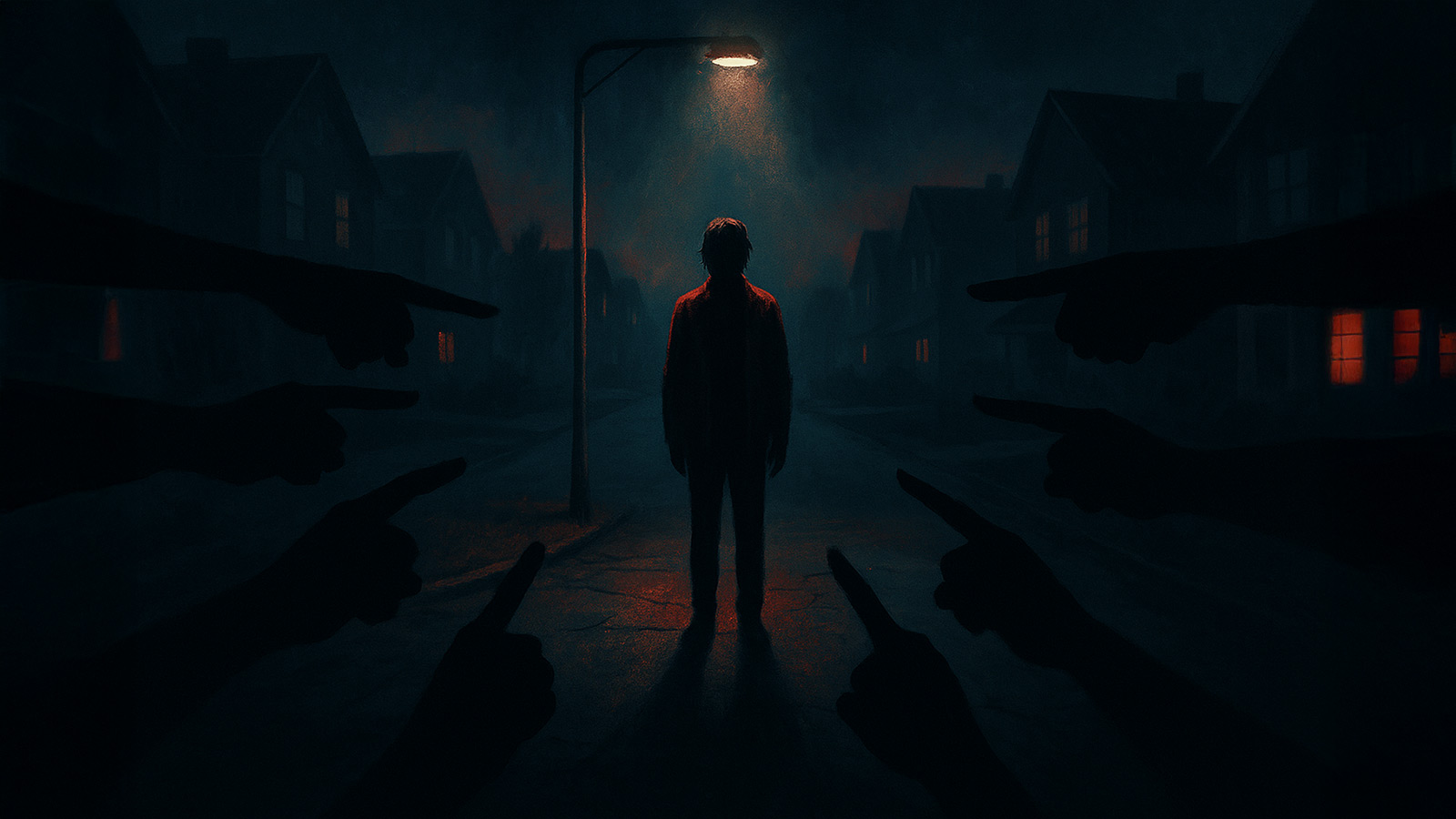

Director Zach Cregger’s new horror film Weapons explores the unsettling notion that the real monsters might not be lurking under your bed, but can instead be found within your own mind.
More than merely a scare tactic, the film illustrates how someone’s own brain can transform them from a decent person into the villain in someone else’s story.
Following his breakout hit with the horror flick Barbarian (2022), in Weapons Cregger presents a psychological nightmare that serves as a twisted exploration of human behaviour. It shows how quickly normal people can turn into agents of cruelty, all while still believing they’re the heroes of the story.
The film opens with the chilling premise of 17 children from the same classroom vanishing without a trace, leaving behind only grainy security footage of them running like helpless little planes. However, the true horror unfolds as the community of Maybrook – a small town in Pennsylvania – spirals into chaos instead of unity.
Parents accuse teachers, neighbours distrust one another and innocent lives are upended in the search for a culprit. This breakdown is grounded in psychological research, showcasing how human behaviour can deteriorate under pressure.
The psychology behind Weapons
Social identity theory is a scientific concept that theorises that your brain is wired to compartmentalise the world into “us” (those we consider good) and “them” (those perceived as threats). This process intensifies when people face fear or stress.
In Weapons, we see this theory in action as the community dismantles itself. Teacher Justine Gandy (Julia Garner) becomes an easy target, not due to concrete evidence, but because she fits neatly into the role of the other – “them”. The parents of the missing children seek someone to vilify, and she becomes the scapegoat of their fears.
This idea is based on decades of research showing that even the flimsiest group divisions can trigger vicious “us versus them” thinking. In laboratory experiments, people assigned to completely meaningless groups (like “overestimators” versus “underestimators”) will immediately start favouring their own group and discriminating against the other.
Here’s where things get truly frightening. The film shows characters doing horrible things while convinced they’re being righteous – this is a phenomenon psychologists call “moral disengagement”.

Think of it as your brain’s built-in excuse generator. When you want to do something that violates your normal moral standards, your mind helpfully provides justifications, such as:
- “it’s for the greater good”
- “they deserve it”
- “everyone else is doing it”
- “I’m just following orders.”
Recent studies show that this isn’t just about film villains – it’s how ordinary people convince themselves that cruelty is justified.
One 2025 study found that when people are under stress (like, say, dealing with missing children), they become much more likely to make cold, calculating decisions that prioritize results over moral principles. Your stressed-out brain rewrites your ethics in real time.
Weapons taps into these, and other, unsettling psychological findings. Take, for instance, the controversial 1971 Stanford prison experiment, where participants tasked with being “guards” quickly adopted sadistic behaviours towards the “prisoners”. Or the equally contentious obedience experiments by American psychologist Stanley Milgram, which demonstrated how ordinary people administered what they thought were lethal electric shocks under authority’s command.
Both the Milgram obedience experiment and Stanford prison experiment are now universally condemned by psychologists as deeply unethical, with experts agreeing that ethics gatekeepers would swiftly bar such studies from proceeding if they were proposed today. These controversial experiments were so harmful to participants that they directly led to major reforms in research ethics, including the National Research Act of 1974 and modern institutional review boards that protect human subjects.
But many still believe that these experiments revealed a chilling truth – almost anyone can become a “bad guy” under the right circumstances. Alarmingly, in Milgram’s tests, around 65% of participants proceeded to maximum voltage shocks, indicating that normal people are vulnerable to psychological manipulation within group settings.
Weapons presents this same dynamic, but within the context of a seemingly idyllic suburban neighbourhood.
The empathy trap
Weapons also shows that the people who care the most about a situation can become the biggest targets. The film doesn’t punish characters for being cruel – it punishes them for being kind.
Take teacher Justine Gandy (Julia Garner). Her downfall isn’t that she’s evil or incompetent. It’s that she cared too much about a neglected student and crossed the invisible boundaries of the “proper” teacher-parent relationship. Her empathy makes her an outsider, and outsiders make perfect scapegoats. The community turns her compassion into evidence of her guilt.
Even more chilling is what happens to Marcus (Benedict Wong), the school principal. In a moment where he shows concern for a child, his care gets twisted into something sinister. His empathy is punished with extreme prejudice, transforming his human decency into malice and destruction.
Recent studies have explored “virtue signalling”: when people perform moral outrage not because they genuinely care, but because it makes them look good socially. The research shows that online moral crusades often have little to do with actually helping anyone and everything to do with personal image management.
Even worse, psychologists have identified “weaponized empathy” – using people’s natural desire to help others to manipulate them into supporting harmful causes. Your compassion becomes the weapon someone else uses against you.
Weapons succeeds as horror because it doesn’t rely on supernatural monsters or gore. Instead, it shows us the real monsters – the ones we become when our psychology works exactly the way evolution has led it to.
The film suggests that the greatest threat to any community isn’t some external evil. It’s the collective decision to abandon empathy, critical thinking and basic human decency in favour of tribal warfare and moral theatre.
As the credits roll over the film’s blood-soaked finale, you’re left with an uncomfortable question: In a crisis, which side of that warfare would you be on? And more importantly, would you even know?
Written by Edward White, PhD Candidate in Psychology, Kingston University
This article is republished from The Conversation under a Creative Commons license. Read the original article.