













TLDR: A single reference to Canada during the Super Bowl halftime show positioned Bad Bunny at the centre of a larger conversation about Latin American identity and belonging in Canada.
Weeks later, a single word from the Super Bowl half-time show continues to reverberate across social media: “Canadá.”
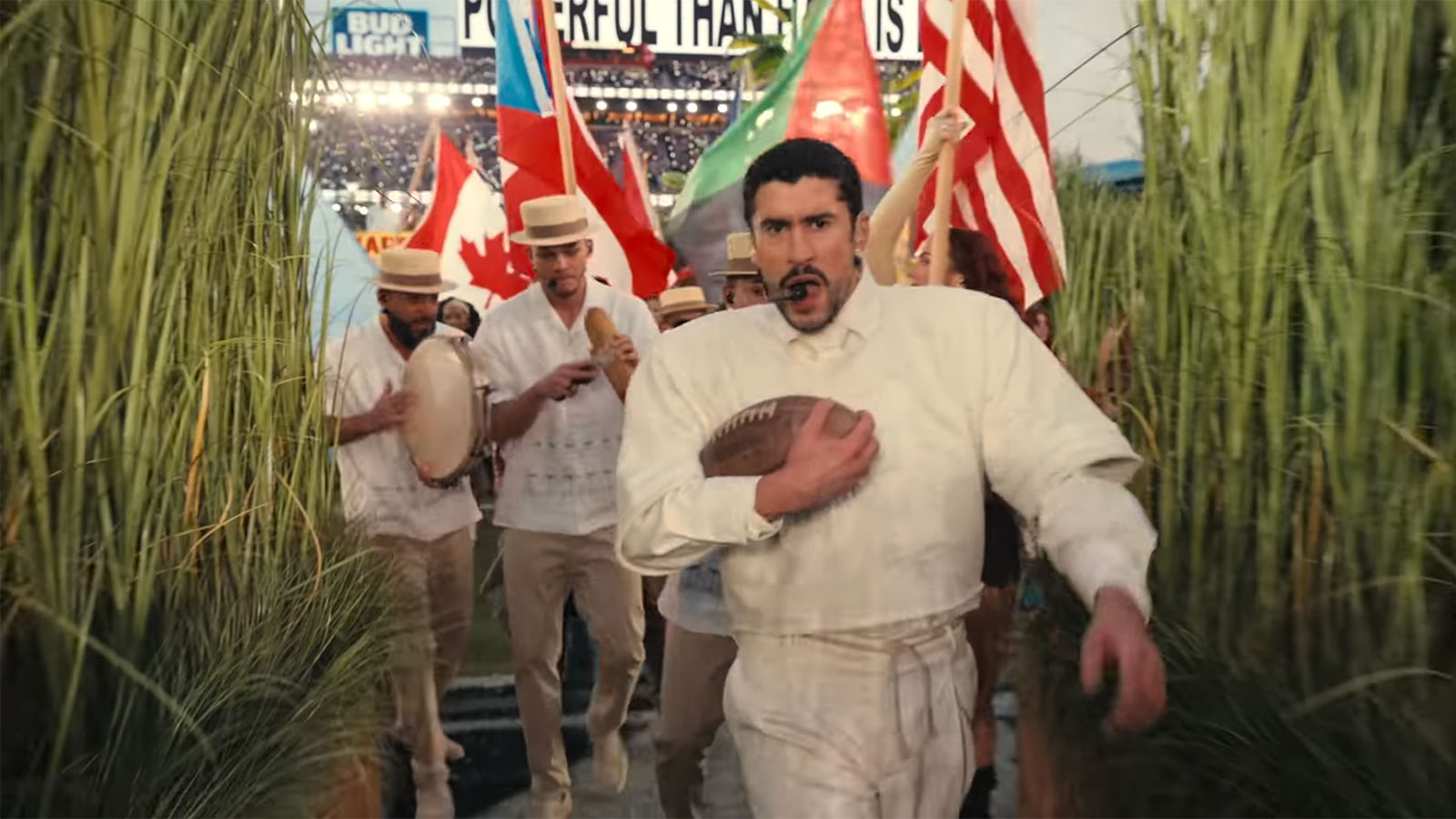
As Puerto Rican artist Bad Bunny named countries across the Americas at the end of the show, he included Canada as an unexpected reference. This timely invocation made visible what is so often overlooked.
More than one million Latin American people live in Canada, according to Statistics Canada, and for those communities, “Canadá” does not register as novelty. It names a known reality in a country where Spanish is now the most spoken non-official language.
Against this backdrop, Bad Bunny’s halftime performance has lingered as a deliberate cultural and historical intervention that centred Puerto Rico with intention while also gesturing toward a wider hemispheric story of the Americas and their entangled histories. What unfolded was not merely entertainment but an anticolonial re-mapping of the Americas.
From the transformation of the football field into sugarcane fields to Bad Bunny’s unapologetic insistence of performing only in Spanish, the performance centred Black, Latin American and Caribbean cultures in a space often framed as the apex of popular culture in the United States.
But this was not just Spanish in the abstract. It was the distinct Puerto Rican Creolized Spanish that is legible across much of the Latin American Caribbean and its diasporas.
And, given the criticism the performance has drawn both before and after the event, it’s worth underscoring that this took place within a space long shaped by uneven representation.
Latin America lives in Canada
As Latin American scholars working and living within diasporas in Canada, that moment reflected questions our students bring and the histories they carry with them.
At McMaster University, our work in Latin American and Latinx studies begins from the premise that Canada is part of the Americas. Through interdisciplinary teaching and research, we bring together students from across the university — some with personal ties to Latin America and the Caribbean, others encountering these histories for the first time — to think hemispherically, with particular attention to Blackness, Indigeneity, migration and the ongoing, persistent and evolving impacts of colonial rule.

And despite the rapid growth of Latin American and Latinx communities in cities like Toronto, Vancouver and Hamilton, scholarship examining their experiences remains limited, with tangible consequences. Latinx students in Toronto, for example, face some of the lowest high-school graduation rates among major demographic groups.
Our research underscores that these lives are not peripheral to the hemisphere, but central to it.
Celebration as a practice against erasure
When Bad Bunny said “Canadá,” he reminded Canadians that they exist within a story they so often imagine unfolding somewhere else.
For many Latin American, Latinx and Caribbean communities in Canada, that moment affirmed a lived experience. For others, it offered an invitation: to recognize that joy can function as resistance, that culture carries memory and that music can be a way of sharing history.
Scholars of popular culture have long noted that Bad Bunny’s work consistently centres Puerto Rico, not only as a place but as a political reality. This melding of lineage and geopolitics is significant, situating the half-time show as a continuation of a tradition in which culture becomes a vehicle for collective hope.
Music historian and multimedia artist Katelina Eccleston, also known as La Gata, argues that music and dance in Black Latin American and Afro-diasporic traditions are never merely esthetic. On an episode of Reggaetón con la Gata, she framed movement as a site of reclamation of the body, space and autonomy.
When dance is stripped of its histories and recast as apolitical entertainment, the social and material conditions that produced those rhythms are rendered invisible.
Consumption without reckoning
At the same time Canadians enthusiastically consume Latin American culture. Music fills playlists, restaurants flourish and millions travel annually to destinations like Mexico, Cuba and the Dominican Republic.
What is often missing, however, is a deeper engagement with the histories of colonialism, displacement, racialization and resistance that shaped these cultures and the lives of the people who carry them.
Bad Bunny’s naming of “Canadá” highlights that Canada is not adjacent to the Americas — it is part of it. It also serves as a reminder that Latin American and Latinx people are not newcomers to be acknowledged only through immigration statistics. They are already active participants in shaping the cultural, linguistic and political lives of this country.
As educators, we see this dissonance daily. Students are eager to learn about the region in ways that move beyond stereotypes and surface-level, performative multiculturalism. They want to see how histories of empire and extraction connect to contemporary migration, climate vulnerability and racial inequities, and they want language, culture and politics to be taught together, not siloed.
In a moment when Canada’s relationship with the U.S. is uncertain, it’s important to remember that Latin America is not only a place Canadians visit for some sunshine. It’s a region with which Canada shares economic ties, political responsibilities and a future.
The Super Bowl half-time show may seem to have been an unlikely site for this reckoning. But culture often arrives where policy lags behind.
In naming “Canadá,” Bad Bunny reminded Canadians that Latin American and Latinx lives are already here, already shaping the country, already demanding to be seen as people with history, presence and possibility.
Written by Rodrigo Narro Pérez, Assistant Professor, School of Earth, Environment and Society, Faculty of Science, McMaster University and Stacy A. Creech de Castro, Postdoctoral Fellow, Faculty of Humanities, Office of the Vice-Provost (Teaching & Learning), McMaster University, McMaster University
This article is republished from The Conversation under a Creative Commons license. Read the original article.

5 Ways to Support HipHopCanada:
- Submit Your Music
- Follow Canadian Fresh (HipHopCanada’s Spotify Playlist)
- Follow us on Instagram
- Follow us on X (Twitter)
- Like us on Facebook