
















TLDR: The elbows of Gordie Howe have become a political symbol for Canada as tensions with Donald Trump escalate. Canadians are ready to fight back — hockey style.
When Canadian ice hockey centre Connor McDavid scored in overtime to lead Canada to victory over the United States in the National Hockey League’s 4 Nations Face-Off tournament in February, Canadian Prime Minister Justin Trudeau posted on social media, “You can’t take our country — and you can’t take our game.”
Trudeau’s comment was a direct response to U.S. President Donald Trump’s repeated denigration of the prime minister as the “governor” of the “51st state.” It captured the escalating tensions between the two countries over trade, tariffs and Trump’s threats to annex Canada.
Meanwhile, the tournament itself, which pitted the top Canadian and American players against one another for the first time in more than a decade, became a representation of these deepening political divisions and showed that hockey isn’t as politically neutral as is often suggested.
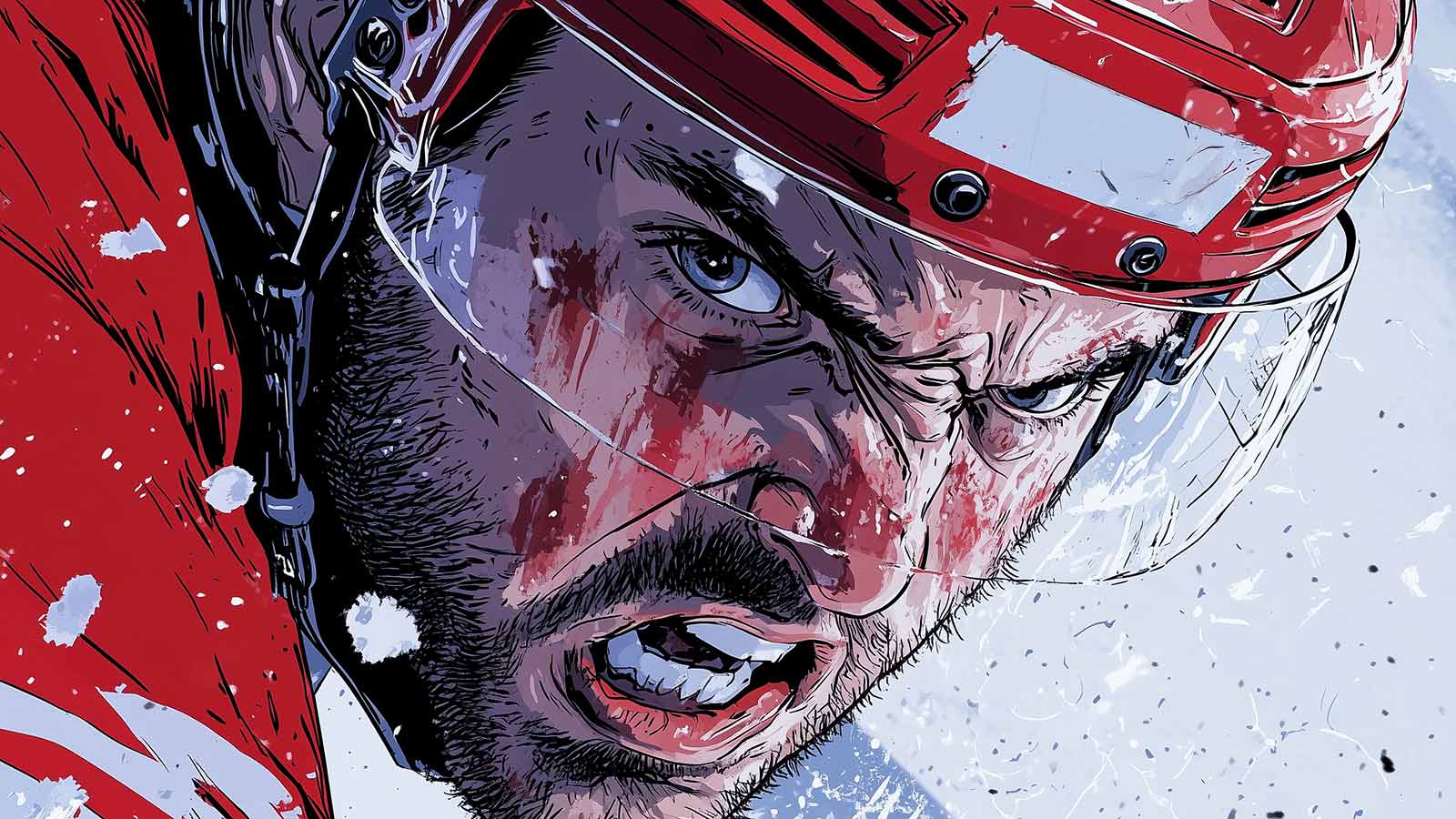
Since the 4 Nations Face-Off ended, hockey analogies and imagery continue to dominate the conversation around Canada-U.S. relations. This time the focus is on Gordie Howe (or “Mr. Hockey” as he was widely known), whose strategic use of elbows on the ice has become a political rallying cry for Canadians.
Canada is “elbows up”
During his professional career from 1946 to 1980, Howe combined skill and scoring ability with toughness, physicality and a willingness to fight when necessary.
In particular, Howe’s practice of keeping his “elbows up” in the corners to ward off belligerents on the opposing team has become a focal point for Canadians’ actions against Trump’s aggression.
The hashtag #ElbowsUpCanada has been trending on social media. Howe’s guidance has been echoed by Canadian comedian Mike Myers on Saturday Night Live and by Trudeau at the Liberal leadership convention that marked the transition to Prime Minister Mark Carney.
In his first speech as Liberal leader, Carney made another hockey reference when he said:

“We didn’t ask for this fight, but Canadians are always ready when someone else drops the gloves. So the Americans, they should make no mistake: In trade, as in hockey, Canada will win.”
While it may be surprising to see such enthusiasm for an “elbows up” approach and for “dropping the gloves” as one would in a hockey fight, this kind of strategic employment of violence fits perfectly with Howe’s longstanding brand of hockey manhood.
“Mr. Elbows” and the “Bashful Basher”
Although Howe’s early nickname of “Mr. Elbows” has received the bulk of the public’s attention recently, his other moniker used extensively by the Detroit media during his first season in the NHL — the “Bashful Basher” — captures even more effectively the style of masculinity that Canadians are currently calling upon in their clash with Trump.
Writing in the Detroit Free Press in 1947, reporter Marshall Dann invited readers to “Meet Red Wings’ Bashful Basher.” Alongside a photo of a youthful Howe innocently sipping a milkshake through a pair of straws, Dann noted:
“Howe not only had proven himself an exceptionally promising rookie, but he also had established the fact that while he might be a malted milk devotee off the ice, he positively was no milk-sop on a hockey rink.”
Howe’s brand of violence was careful and calculated, rather than reckless or emotional. Even when he used his fists to batter an opponent — such as in his famous 1959 fight with New York Rangers enforcer Lou Fontinato — Howe presented himself as a reluctant and reasonable fighter who conformed to the idealized, manly “code” of hockey.
He resorted to fighting only to defend smaller teammates and to deter even more harmful forms of violence, such as stick attacks or overly aggressive hits. Far from a wild brawler, Howe was a calm protector, governed by a sense of honest accountability for his actions.
Author Don O’Reilly’s 1975 biography Mr. Hockey also highlights the image of “two Gordie Howes — quiet, unassuming, and bashful off the ice and aggressive and competitive on the ice.”
O’Reilly contrasts “the mild-mannered, smiling, innocent-faced Howe, the clean-cut All-Canadian-American boy” with his more ruthless counterpart: “The guy who excels with his elbows as weapons, a man who, his opponents say, is skilled with the illegal high stick and so devious that the officials often fail to see the offense.”
Likewise, a 1962 Time magazine profile quoted a rival coach as saying:
“When Howe gets knocked down, he looks like he doesn’t care. But when he’s getting up, he looks for the other guy’s number. A little later, the guy will have four stitches in his head.”
Mr. Hockey and Canadianness
A combination of humble manliness and controlled violence firmly established Howe’s masculine credentials within the culture of hockey. More broadly, Mr. Hockey became an admirable embodiment of the most valued manly qualities of the postwar period in North America.
Howe’s strategic use of fighting also normalized the high level of violence in hockey by showing that it could be measured and purposeful, in accordance with the informal code of expectations that governed the game.
Although critics of fighting and violence have become more outspoken in recent years, these values remain integral to hockey culture at the highest level and an influential point of reference for what it means to be a “true” hockey fan and a patriotic Canadian.
In the current political climate, it is perhaps the title of the story that appeared in Life magazine in 1959 that resonates most clearly: “Don’t mess around with Gordie. Hockey’s tough guy (Lou Fontinato) discovers that the game’s best player (Gordie Howe) is a rough man in a fight.”
With their “elbows up,” Canadians are counting on a Gordie Howe-style response — rational, expert and effective — in a trade war with the United States that may just be getting started.
Written by Stacy L. Lorenz, Vice Dean and Professor, Physical Education and History, Augustana Campus, University of Alberta and Braeden McKenzie, Postdoctoral Fellow & Equity Data and Research Analyst, University of Victoria
This article is republished from The Conversation under a Creative Commons license. Read the original article.