









TLDR: Mickey 17 is a visually striking dystopian satire by Bong Joon-ho, exploring cloning and exploitation, though its revolution feels restrained.
Written, directed and co-produced by Bong Joon-ho, Mickey 17 is another exciting, discussion-worthy film from the acclaimed Korean director. For fans of his previous work, such as Oscar-winner Parasite (2019), it’s well worth seeing – even though the film is not without wrinkles.
Like Bong’s earlier films, Mickey 17 combines artful world-building, an impeccable cast, social satire, anarchic humour and a taste for the grotesque (a shot of a severed hand floating past the porthole of a spacecraft’s cafeteria lingers in the mind).
It’s a measure of Bong’s success to date that, as well as granting him full editorial control of the film, Warner Brothers reportedly provided a budget of US$120 million (£93 million). It’s a large sum by current Hollywood standards, though still only half that of mega productions like Avatar (£185 million) and The Dark Knight Rises (£195 million).
Enter Mickey 17
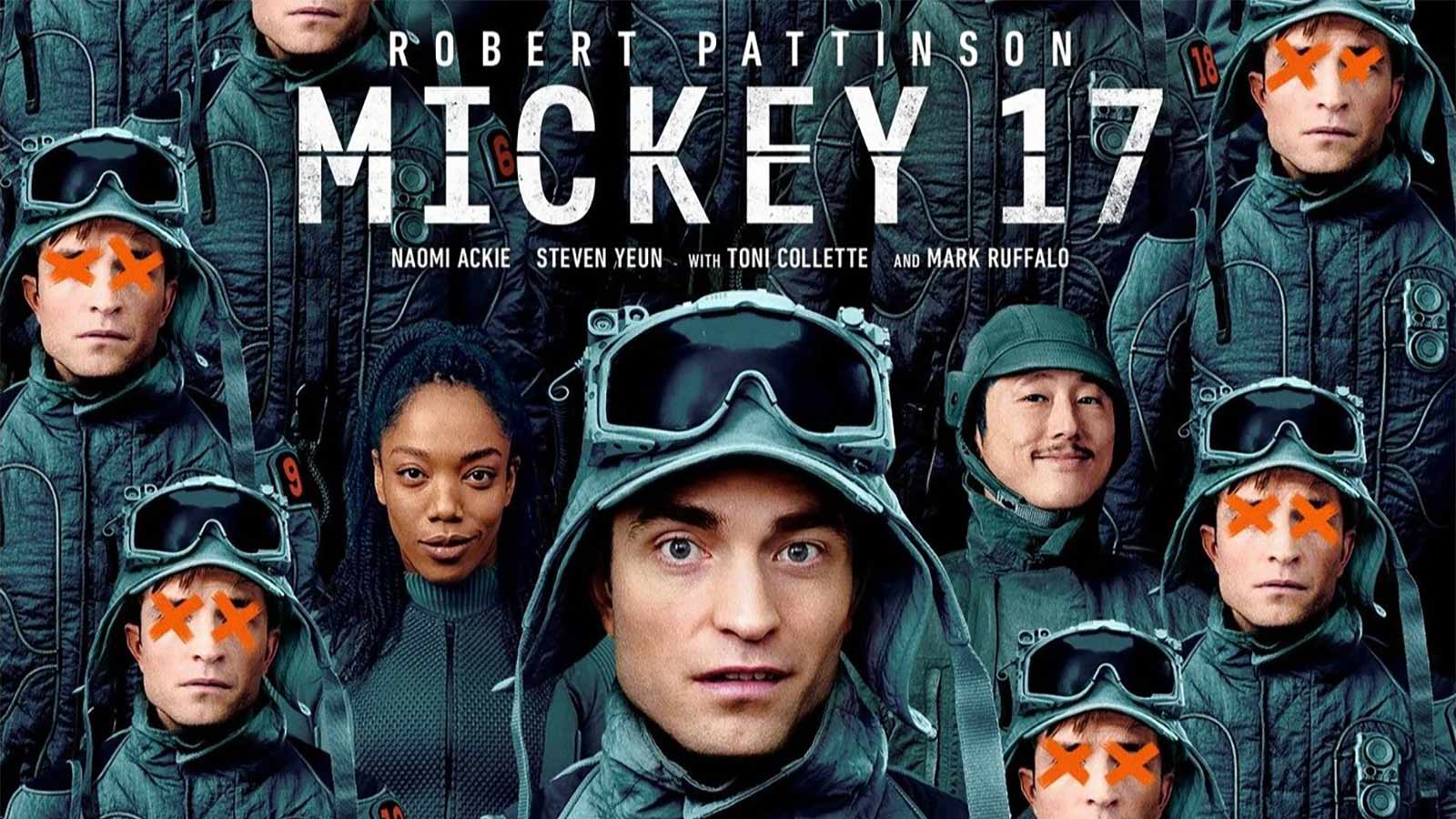
Set in 2054, Mickey 17 follows a mission to establish a human settlement on an inhospitable alien planet. In this imagined future, it has become possible to replicate human beings with total accuracy using an advanced form of 3D printing.
Although outlawed back on Earth, human printing is legal in the remote regions of space, where disposable workers known as “expendables” can be reprinted on demand each time they perish. At the start of the film, Mickey is killed and reprinted 16 times before an accident leads to two Mickeys (numbers 17 and 18) coexisting in what is referred to as a “multiples violation”.
Mickey’s existence is nightmarish: an endlessly repeated cycle of exploitation, death and rebirth. Combined with some memorably surreal imagery – most notably a sequence in which multiple Mickeys are shown emerging from the printer like pages from a photocopier – this chilling scenario sometimes brings the film within the orbit of the horror genre.
Bong Joon-ho’s dystopian satire
Stylistically and thematically, Mickey 17 bears a clear resemblance to two of Bong’s previous films: Snowpiercer (2013) and Parasite. Where it diverges from its predecessors is the room it creates for hope.
In Snowpiercer, a bleakly comic eco-dystopia, the oppressive society in which the film is set is overthrown when a train housing the last human survivors of a new ice age is sabotaged by workers from the lower-class tail section.

The ambiguous final scene of the film depicts the main characters exiting the train only to be confronted by a frozen, potentially uninhabitable wasteland. If the train stands for global capitalism, Snowpiercer seems to imply that the prospects for a life beyond capitalism are slight.
Parasite has likewise often been read as a fable about contemporary capitalism. It follows a lower-class family as they gradually try to take over the home of a much wealthier family, waging a kind of covert class warfare from a hidden subterranean level beneath the house. In the end, however, the poorer family is publicly humiliated and violently driven back underground to plot its revenge.
Mickey 17 is ‘more hopeful’
Whereas both Snowpiercer and Parasite can therefore be seen as staging revolutionary struggles that are in different ways defeated, Mickey 17 is more hopeful.
It is somewhat disappointing, then, that other than an impassioned anti-colonial speech in the final act, the victory over oppressive systems mainly involves throwing out the few bad apples at the top before resuming business as usual. In this regard, the stalled revolutions of Snowpiercer and Parasite are more persuasive.
Mickey 17 is a well-made and successful film. It is engaging, witty, strange and at times visually stunning. Although the film overstretches itself in attempting to envisage a future beyond dystopia, it is nonetheless gratifying in the age of the superhero franchise to see a bigger budget Hollywood film that has something to say and dares to take some creative risks.
Written by Sean Seeger, Senior Lecturer, Department of Literature Film and Theatre Studies (LiFTS), University of Essex
This article is republished from The Conversation under a Creative Commons license. Read the original article.