












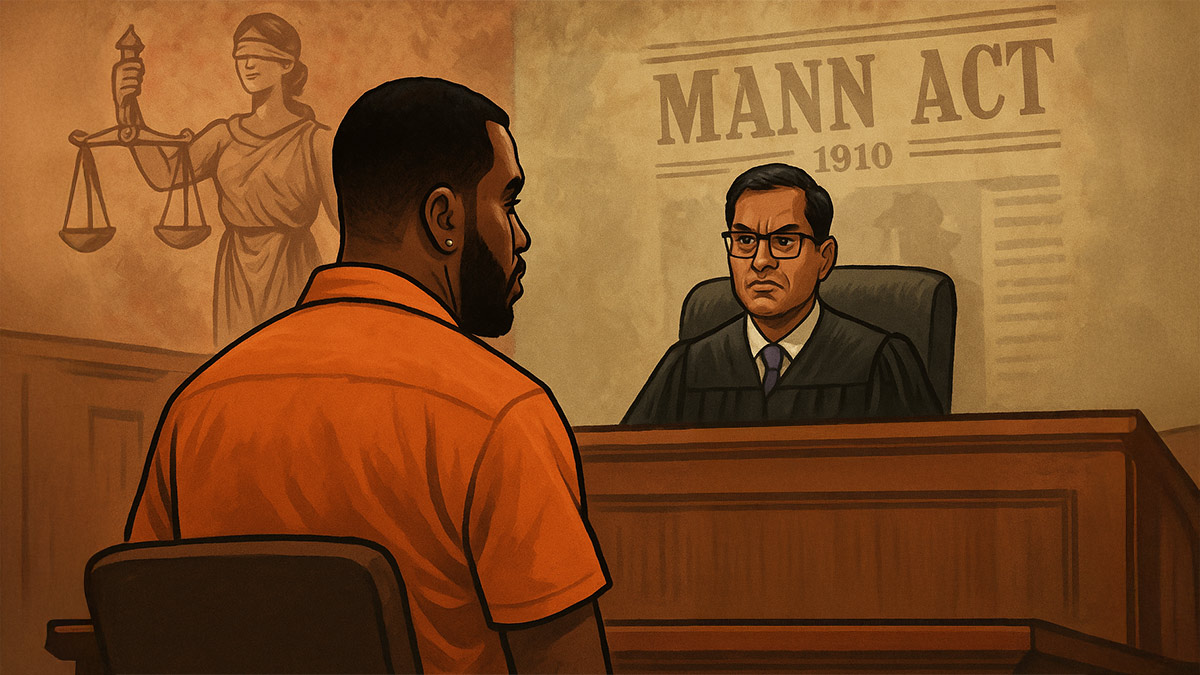

In a bold legal maneuver late last night, attorneys for Sean “Diddy” Combs filed a motion asking the court to set aside the jury’s partial verdict or grant a new trial. The filing—submitted in support of a renewed Rule 29 request—argues that the two remaining Mann Act convictions are “legally unsupported, constitutionally flawed, and inconsistent with longstanding Department of Justice policy.”
The jury, after rejecting the government’s trafficking and racketeering (RICO) charges, returned convictions only on two counts under the Mann Act. But as Diddy’s defence team makes clear:
“This conviction stands alone, but it should not stand at all.”
No Profit, No Coercion, No Sex
According to the defence, Diddy’s case is unprecedented. In the 120-year history of the Mann Act, no one has ever been convicted under 18 U.S.C. § 2421(a) without evidence of commercial motive, coercion, sexual activity, or financial gain. The jury confirmed that Combs was not involved in trafficking, coercion, or sexual assault—and that all participants were adults who chose to travel voluntarily.
“Mr. Combs is the only person ever convicted under this statute where there was no commercial motive, no coercion, no sex, and no financial benefit.”
The performances in question, the defence says, “were private, consensual, and often recorded and rewatched by Combs and his partners”—which the defence argues is protected under the First Amendment.
A Law Rooted in Racism and Outdated Morality
The motion also confronts the racist origins of the Mann Act, originally titled the White Slave Traffic Act of 1910. The law came from a wave of moral panic in the early 20th century, fuelled by fears that “white slavers” were coercing middle-class white women into prostitution. One of the bill’s original backers claimed that American-born girls were being lured away and “sold to all men who can pay the price—young men or old, clean or unclean, healthy and diseased, Black or white.”
As the defence argues, the statute was designed to police sexuality and protect white women from interracial relationships, particularly those involving Black men. It was later used to target high-profile Black figures like Jack Johnson, the first Black heavyweight boxing champion, who was prosecuted in 1913 for traveling across state lines with his white girlfriend.
“For over 75 years, DOJ has stated that Mann Act enforcement should be limited to cases targeting defendants who violated the statute for commercial gain.”
Despite updates to the statute’s language, the defence asserts that its racial and moralist origins remain troubling in how it’s been selectively enforced throughout history.
Evidence Meant for RICO Used to Convict Under Mann Act
The defence also criticizes the government’s trial strategy, claiming prosecutors introduced “inflammatory evidence” only tied to the dismissed RICO and trafficking charges. They argue that under Rule 33 a new trial is required because the conviction came from prejudice evidence that would never have been admissible in a trial focused solely on the Mann Act counts.
“The White Slave Traffic Act makes it an offence knowingly to transport any woman or girl… for the purpose of prostitution, debauchery, or for any other immoral purpose. Commercialism is not essential to a violation of the Act… However, as a general rule, prosecution should not be instituted in the so-called ‘non-commercial’ cases.” — Caminetti v. United States, 242 U.S. 470
What Comes Next?
The motion now asks the Court to either:

- Acquit Mr. Combs outright, based on the lack of evidence satisfying the legal elements of the Mann Act, or
- Order a new, narrowly focused trial, limited to admissible evidence under the Mann Act alone (per Rule 33).
- Either way, the defence insists, the current conviction cannot be allowed to stand.
Whether the Court grants the motion remains to be seen. But one thing is clear—Diddy’s legal team is not backing down. They’re not only challenging the government’s interpretation of the law—they’re also calling attention to the continued use of a controversial statute derived from racism, fear, and moral policing.
HipHopCanada will continue to follow all developments from the courtroom as this landmark case unfolds.