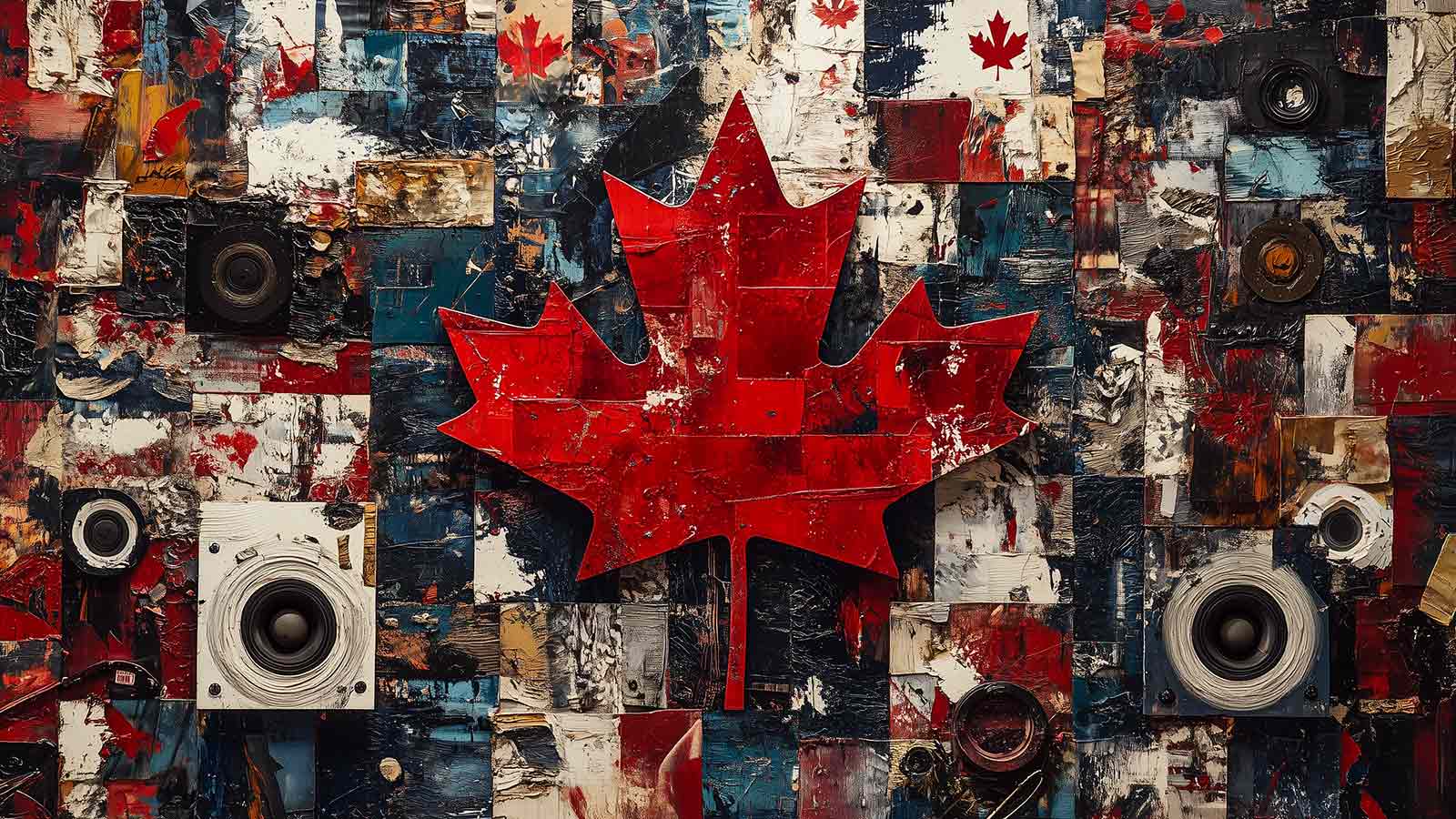


















TLDR: In reaction to recent tariffs and annexation threats by Donald Trump, artists and content creators in Canada are producing patriotic protest music that celebrate the identity and resilience of the country.
Some Canadian musicians and content creators are reflecting a sudden surge in patriotism as they listen anxiously to the crescendo and decrescendo of United States President Donald Trump’s rhetoric against their country.
The pro-Canada songs currently spreading across social media, including some by Canadian celebrities, reveal a range of reactions to Trump’s tariffs and annexation threats, while also contributing to the national mood.
These songs are striking, because Canadians have in recent decades been relatively uninterested in loud assertions of nationalist sentiment, outside of sporting events.
Shared identity
When shared identity has been emphasized, it has often been to promote provincial separatism or the rights of Indigenous Peoples. Uncritical Canadian nationalism has, to some, felt inappropriate since the 2015 findings and recommendations of the Truth and Reconciliation Commission.
Patriotic feelings were further complicated during the pandemic, when the flag was co-opted by people opposing public health restrictions.
In these contexts, many commentators have for some time struggled to locate a shared Canadian attitude toward the nation.
Terms such as “multicultural nationalism,” “plural nationalism” or even “a postnational country” are perhaps the best descriptors of nationalist sentiment when it’s expressed in Canada.
In music, Canadian nationalism is only rarely articulated, beyond performances of the anthem. The pop songs that tell particularly Canadian stories tend to be more sentimental than nationalistic — songs like Gordon Lightfoot’s “Canadian Railroad Trilogy” or Anne Murray’s “Snowbird.”
Yet something has shifted amid Trump’s verbal and economic attacks on Canada began, as the reactions of sports fans to performances of the U.S. anthem have also demonstrated.

Songs on the trade war
As a scholar of music and nationalism, I’m interested in what the several dozen songs about the trade war that I have located might suggest about that shift.
The patriotic songs by apparently Canadian creators that I discuss here are all drawn from Facebook and Instagram feeds and searching YouTube using English-language terms such as “Canada tariffs song,” “51st state song,” and “Canadian patriotic song.” A deeper dive into Québec-specific, francophone and multilingual responses would be additional significant ways of looking at this.
They represent an array of musical styles, including rock, metal, reggae, country, folk and pop.
Most of the songs I found have original music: those setting new lyrics to existing copyrighted tunes are not included here. I also excluded the few songs with potentially slanderous material. A number make use of AI. Indigenous and self-identified immigrant perspectives so far seem under-represented.
Patriotism, Canadian-style
An explicit patriotism is the most striking — and new — feature of this repertoire. What is clear in this sampling, however, is that Canadians still remain allergic to jingoistic nationalism — blindly professing or adhering to belief in the virtue of one’s nation.
TV host and comedian Tom Green’s “I’m a Canadian”, for example, is a humorous, self-deprecating song that celebrates Canada’s uniqueness without being exclusionary or making claims of exceptionalism.
This gentle Canadianism is also reflected in stereotypically polite refusals of Trump’s offer to join the United States: “Thanks, but we’re already great! We don’t need to borrow your stars or your fate!“
These songs celebrate politically benign features of Canada — its natural world, its cold winters, its food and its love of sports.
Canadian values, meanwhile, are presented as compassionate, noble and good: “We stand for truth and kindness, and we help those in need.”
Where Canadians are the primary audience, resilience is often foregrounded. The soothing singer-songwriter style of “Canada’s Home,” for example, gently encourages strength and fortitude. Again, strong moral values are emphasized: “Canada’s integrity is what bullies can’t stand.”
Songs for the U.S.
Many songs seem aimed at an American audience, in addition to a Canadian one.
In “We Used to Be the Best of Friends” by Jim Cuddy, a Canadian Music Hall of Famer and Blue Rodeo frontman, the listener is politely reminded of the long friendship between the U.S. and Canada. Cuddy uses a charming folk style to remind Americans of cultural and political experiences shared with Canada, and of challenging times when Canadians had their back.
Cuddy’s wistfulness for a threatened friendship contrasts with songs that take a more assertive stance, especially in response to Trump’s 51st state threats. With titles like “Canada is Not For Sale,” such songs emphasize the flag and the rights of Canadians.
A few songs go further still, abandoning traditional courtesies for sarcasm and even rudeness.
Assertions of Canadian strength recur repeatedly. The “elbows up” movement, inspired by the moment Canadian comedian Mike Myers mouthed this hockey phrase associated with Gordie Howe on Saturday Night Live, has produced several songs about Canada’s readiness to resist American actions.
Although songs of this type are more defiant, they nevertheless hold true to traditional Canadian values. “Elbows Up Canada!” celebrates unity and “holding the line” together. Using AI-created video imagery, this song juxtaposes images of early settlers with a brief image of Indigenous people in traditional dress or regalia standing with a Canadian flag, reflecting the lyrics, “side by side”.
I’ll note that this song’s brief depiction of Indigenous presence is unusual among songs I found. In meditations about national unity, most of these creators make no allusions to Indigenous Peoples, or Canada’s ethnolinguistic or racial diversity.
In so doing, these songs minimize identities that are important to many Canadians in order to bolster national identity. They implicitly encourage all citizens to put aside what separates them to address an external threat.
In a cross-border context, these songs do not articulate hatred of Americans as a people. The frustration they express is consistently directed at Trump, not the U.S. as a whole.
But with a looming election in Canada and the actions and rhetoric of both countries shifting every day, it’s possible this may change. Will the music and the cultural conversation become more hostile? Will Canadians themselves grow concerned if their country’s patriotic turn becomes belligerent?
As Cornell University political scientist Benedict Anderson argued in 1983, a nation is ultimately an “imagined community,” because we can never know everyone within it. The feeling of national belonging happens solely in our minds and is reinforced by the stories we tell ourselves.
Music has a unique capacity to participate in this reinforcement, building shared identity across vast and varied spaces. It can also allow us to differentiate ourselves from others. Both capacities are being fully exploited in this challenging moment.
Written by Emily Abrams Ansari, Associate Professor of Music History, Western University
This article is republished from The Conversation under a Creative Commons license. Read the original article.