









Laying bare our collective deep-lying, half-acknowledged fears and phobias, horror has always been, to quote critic Fredric Jameson, a “socially symbolic” genre.
Contemporary horror, particularly since the breakout success of Jordan Peele’s race and class nightmares Get Out (2017) and Us (2019), has frequently flaunted its social-allegory credentials. Recent years have seen films allegorize spousal abuse (The Invisible Man, 2020) and dating-app predators (Fresh, 2022), among numerous other hot-button cultural issues.
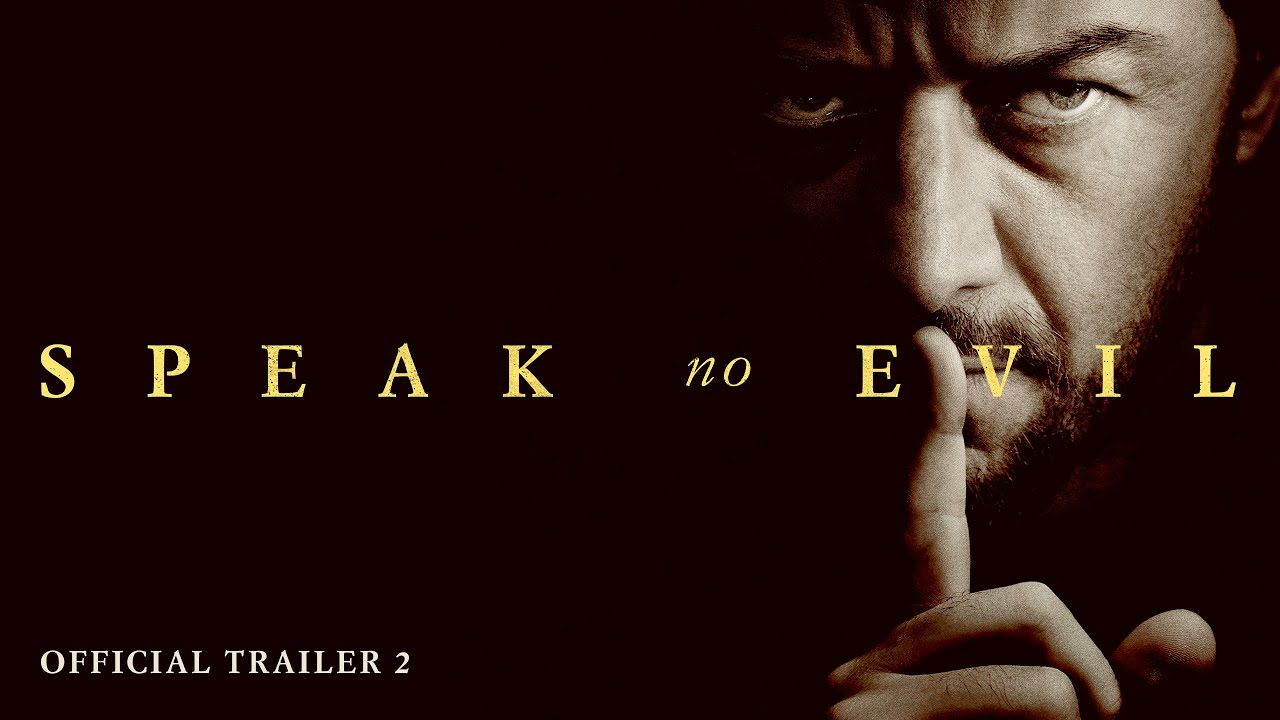
Speak No Evil, by director James Watkins (a remake of Christian Tafdrup’s 2022 Danish film of the same title) also explores contested cultural terrain. Here, the focus is on the seething resentment between rootless corporate cosmopolitans and a rural working-class, condemned to entertain tourists with their rustic “authenticity”.
Versions of this narrative have been a horror staple for years, from The Texas Chainsaw Massacre (1974) to Hostel (2005). But it is refurbished here by the ostensibly tranquil Devon setting and an all-too-topical focus on competing versions of masculinity.
Ben (Scoot McNairey) and Louise (Mackenzie Davis) are a rather pallid American professional couple adrift in drearily grey, impersonal London. Their basic unhappiness expresses itself through the intense anxiety and obsessive compulsive disorder of their daughter Agnes (Alix West Lefler).
For want of any better weekend plan, they accept an invitation from Paddy (James McAvoy) and his much younger wife, Kiara (Aisling Franciosi) – chance acquaintances from a recent holiday in Tuscany. Having clearly never watched a horror movie, they head down to the couple’s remote and isolated (no phone signal, of course) west country farmhouse. There Paddy and Kiara live with their mute son, Ant (Dan Hough).
From the moment of their arrival, Paddy’s boisterously transgressive – verging on aggressive – masculinity, which both appalled and invigorated the bloodless Ben in Tuscany, is back on full display.
Over their increasingly uneasy stay, Paddy – a doctor (or so he claims) who has turned his back on his medical practice to live off the land – violates his guests’ bougie presumptions at every turn. Almost his first act as host is to force the vegetarian Louise to sample the roast goose slaughtered in her honour. He justifies his provocations with Jordan Peterson-style declarations about the need for authenticity and directness to combat the dislocations of modern life.
By contrast, Ben and Louise are almost as tongue-tied and helpless to respond as the mute Ant. The film’s title plays off the idea that ingrained middle-class squeamishness about giving offence can slide into a kind of learned helplessness in the face of actual, even lethal, threat.

As Paddy and Kiara’s increasingly challenging behaviour pushes Louise’s growing unease towards full-blown panic (her entirely justifiable reactions make her an effective audience surrogate), Ben is challenged to find where, if anywhere, he has the strength to defend his family against imminent catastrophe.
The excruciating social interactions of the film’s first hour share some of the slow-motion car-crash quality of Mike White’s HBO series The White Lotus. At the same time, the manifest hostility and latent violence behind Paddy’s blokey facade also makes victims of the audience – powerless to force Ben and Louise to act on the multiple red flags they are too inert to recognize and too polite to react to.
This lends this section of the film a flavour of Michael Haneke’s exercise in spectatorial masochism, Funny Games (1997). And in the inevitable final act lurch into extended bloody mayhem (alongside an unmistakable shout out to Kubrick’s The Shining), the film reveals its most important antecedent: Sam Peckinpah’s Straw Dogs (1971).
That film is another examination of a fish-out-of-water American in the English south-west, whose masculinity is mocked and menaced by hostile locals until he is ultimately forced to decide the extent to which his survival depends on his own capacity for extreme violence.
In truth, none of these comparisons do Speak No Evil many favours. Paddy’s evidently malign intentions are so clearly signposted that the social satire is significantly blunted. And the film could fairly be charged with some dubious assumptions of its own about the rural folk.
Ben and Louise’s endless diffidence in the face of what, to the audience, is blindingly obvious peril prompts increasing irritation, rather than terror. And neither in the buildup, nor in the fairly routine, if efficiently staged, pandemonium of the climax does the film match the merciless intensity or extremity that make Straw Dogs so enduringly powerful and controversial. It evokes the work of Swedish writer August Strindberg more than the westerns for which Peckinpah is known.
Driven by a powerhouse performance from a jacked-up McAvoy, Speak No Evil is certainly entertaining enough. The intensely claustrophobic atmosphere (with only three minor speaking parts beyond the two families, and the great majority of the action unfolding in and around the farmhouse) is effectively unsettling.
The film even gains a fortuitous currency from the echoes of US vice-presidential candidate J.D. Vance’s creepy misogyny and neo-natalism in Paddy’s assumptions about patriarchy and hunter-gatherer he-man beliefs. But ultimately, Speak No Evil lacks the rigour or genre-bending ambition to prompt the kinds of animated cultural conversation at which it seems to aim.
Written by Barry Langford, Professor of Film Studies, Royal Holloway University of London
This article is republished from The Conversation under a Creative Commons license. Read the original article.