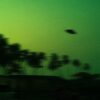










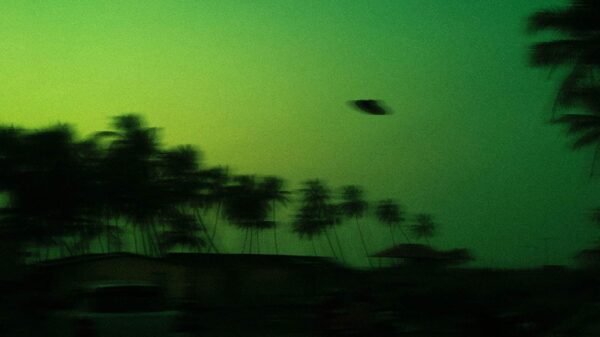





A committee set up by NASA has examined about 800 reports of unidentified anomalous phenomena (UAPs), or what most of us would call UFOs (unidentified flying objects). NASA defines these events as sightings “that cannot be identified as aircraft or known natural phenomena from a scientific perspective”.
The creation of this committee shows that NASA is taking potential extraterrestrial events very seriously. On Wednesday, May 31 2023, the committee held its first public meeting to discuss what it is doing and what it has found so far, ahead of a full report later this year.
It revealed some reports are easy to explain as boats, planes or weather, some had comical, lunch-based origins, and only a few remain a mystery.
The committee is led by astrophysicist David Spergel and is made up of a team of experts ranging from university professors to a former astronaut. The study has been using declassified reports and images to try to explain some of the mysterious reports, which come from all sorts of sources including military personnel and commercial airline pilots.
Sean Kirkpatrick, director of the US Defence Department’s All-domain Anomaly Resolution Office (AARO), which also investigates such claims, says it receives between 50 and 100 new reports of UAPs each month.
While UAPs are essentially just a different name for UFOs, they don’t specifically have to be in the air. Any anomalous phenomena are included, whether they are on land, sea, air or space, so this is a slightly wider definition than just unidentified flying objects. Kirkpatrick also says that most UAPs are easily explained – for example, boats that are low on the horizon tricking pilots with strange perspectives. Only about 2-5% of the database is truly anomalous and cannot yet be explained.
There are many examples of such events that initially appear mysterious but have innocent explanations. One example occurred at an observatory in Australia, where bizarre radio signals were detected. The confusing signals had strange characteristics, but researchers observed that they were mostly seen around lunch time. It turns out that the instruments were observing microwaves leak out from the lunch room as people prepared their food.
Declassified information
Some of the data being studied by NASA has been declassified – cleared for release – by the US military. Whether or not footage is classified is determined by who and what took it, not what the footage was of. For example, if a fighter jet took a photo of the Statue of Liberty it would be classified. Not because of the subject, but because of what took the photo. The US doesn’t want to show off its imaging capabilities to the whole world.

Another amusing revelation came from Scott Kelly, a former NASA astronaut with an impressive resumé, who is also on NASA’s UAP committee. He has decades of experience as a navy pilot, spent an entire year on the International Space Station, and now sits on the UAP committee.
At the recent panel meeting, he described a flight near Virginia Beach, during which he and his co-pilot were convinced they flew right by a UFO. Upon re-examination, it turned out to be something much more down-to-Earth. Kelly said: “I didn’t see it. We turned around, we went to look at it, it turns out it was Bart Simpson – a balloon.”
This highlights the difficulty of analysing footage and reports that come from such a wide range of sources. Much of the data used at the moment is low quality, making it harder to unravel the mysteries it might contain. As a result, the committee is hoping to remove the stigma around reporting sightings to encourage more people to come forward with their anomalous observations.
In particular, it hopes that commercial pilots will become less reluctant to report strange encounters. Pilot reports might help explain more of the footage the committee receives, especially if some of it is high quality, reliable data.
Indeed, the quality of recordings was the biggest issue the panel faced in its preliminary analysis. Typically, sightings are of objects that appear small and are often moving in strange ways. According to committee members, the underlying problem was that these sightings or “encounters” are often recorded on cameras or sensors that are not designed to accurately capture these strange events.
An apparent UFO could actually be the result of a glitch in an old camera, or a person’s perspective being tricked by odd lighting and distant objects.
Online harassment
These confounding factors are turning out to be difficult to disentangle. The other big issue that members of the UAP committee has faced is online harassment, adding to the stigma of doing work in this area. “It is really disheartening to hear of the harassment that our panellists have faced online because they’re studying this topic,” said Nicola Fox, science chief at NASA. “Harassment only leads to further stigmatisation.”
Since this public meeting, an American whistleblower with a background in government intelligence has claimed that the US may be in possession of even more concrete evidence of UAPs. NASA has not responded to this claim, although no additional evidence has yet been presented by the whistleblower. While the studies so far haven’t found anything that can be declared extraterrestrial, the public meeting shows an interesting change of pace for NASA and UFO sightings. In the past, the agency has mostly sought to debunk claims, but now it is very publicly investigating reports and discussing what it finds on live TV.
Later this year, a full report will be released with even more details and findings from these investigations. No UFOs or aliens just yet, but NASA is now taking claims of the UAPs very seriously and seems determined to understand them all.
Written by Christopher Pattison, Researcher at the Institute of Cosmology and Gravitation, University of Portsmouth
This article is republished from The Conversation under a Creative Commons license. Read the original article.